



Sorensen Programmable DC Power Supplies
AMETEK Programmable Power offers Sorensen™ programmable DC power supplies ranging from compact benchtop and rack-mount instruments to modular, high-power, bidirectional and regenerative systems. The portfolio supports development, design validation, qualification, production and system-level testing across aerospace and defense, automotive and electrification, semiconductor, industrial, energy-storage, renewable-energy and AI data center applications.
Choose from unidirectional DC sources for stable, precise output; modular high-power platforms for scalable system requirements; and bidirectional regenerative source/sink systems for battery cycling, battery simulation, power-conversion validation and energy recovery. Available platforms span low-power laboratory use through multi-megawatt parallel configurations.
Need help selecting the right programmable DC power supply?
Download the Guide: Selecting the Right Programmable Power Solution.
Compare required voltage, current, power, form factor, channel count, dynamic response, control interfaces, regeneration, cooling and scalability to identify the appropriate DC power platform for your application.
Choose from unidirectional DC sources for stable, precise output; modular high-power platforms for scalable system requirements; and bidirectional regenerative source/sink systems for battery cycling, battery simulation, power-conversion validation and energy recovery. Available platforms span low-power laboratory use through multi-megawatt parallel configurations.
Need help selecting the right programmable DC power supply?
Download the Guide: Selecting the Right Programmable Power Solution.
Compare required voltage, current, power, form factor, channel count, dynamic response, control interfaces, regeneration, cooling and scalability to identify the appropriate DC power platform for your application.

Asterion DC ASA Series
3-Channel Programmable DC Power Supplies
Voltage: 60V to 600VPower: 3-Channels x 600W (1800W Total Power)
Overview: High Performance 3-Channel Programmable DC Power Supplies

Asterion DC ASM Series
3-Channel Programmable DC Power Supplies
Voltage: 40V to 600VPower: 3-Channels x 1700W (5100W Total Power)
Overview: Enhanced 3-Channel Programmable DC Power Supplies

Asterion DC Series
High-Performance DC Power Supplies
Voltage: 40V, 60V, 80V, 100V, 150V, 200V, 300V, 400V & 600VPower: 1.7kW, 3.4kW, 5kW & 10kW
Overview: High Performance DC Power Supplies
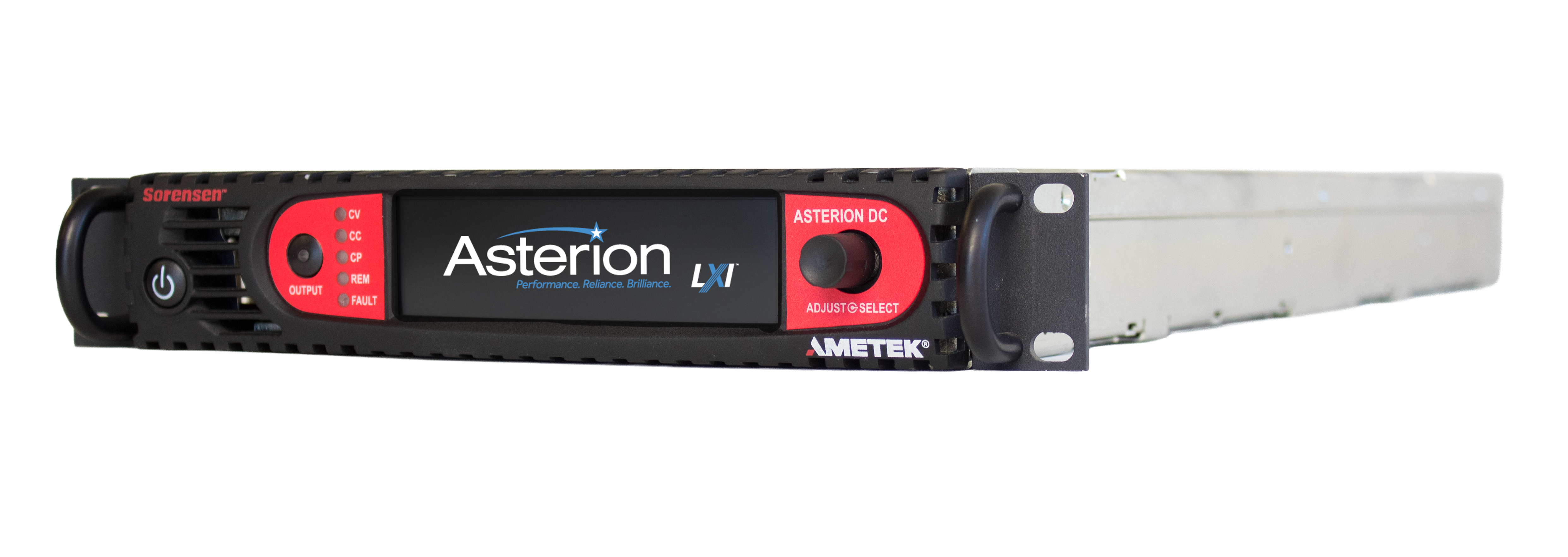
Asterion DC Half-Rack Series
Asterion DC Half-Rack Series – 1.7 kW
Voltage: 40 V, 60 V, 80 V, 100 V, 150 V, 200 V, 300 V, 400 V & 600 VPower: 1.7kW
Overview: Compact, high-performance programmable DC power supplies
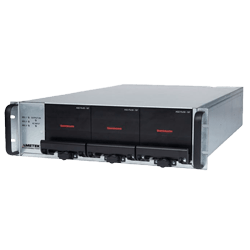
ASD FLX Series
Modular Water-cooled DC Power Supplies
Voltage: 40V–160VCurrent: 167A–8000A
Power: 10kW–320kW
Overview: Programmable Modular Water-cooled DC Supplies
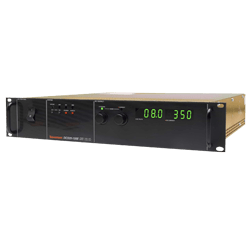
DCS Series
Switched Mode DC Power Supply
Voltage: 8V - 600VCurrent: 1A - 350A
Power: 1kW - 3kW
Overview: DC Programmable Switching Supplies
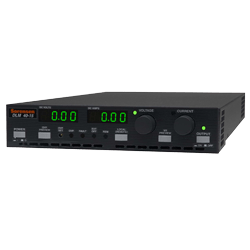
DLM 600
1/2 Rack Programmable DC Power Supplies
Voltage: 5V - 300VCurrent: 2A - 75A
Power: 375W - 600W
Overview: 1/2 Rack Programmable DC Power Supplies
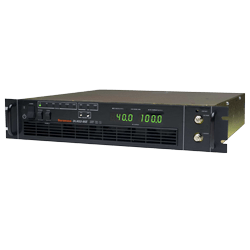
DLM 3-4 kW
2U Rack Programmable DC Power Supplies
Voltage: 5V - 600VCurrent: 5A - 450A
Power: 3kW - 4kW
Overview: Programmable DC Power Supplies
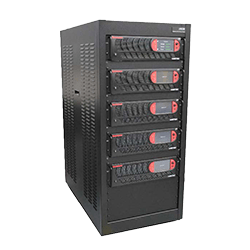
HPX Series
High Power Density Programmable DC Supply
Voltage: 10 V to 1,000 VCurrent: 45 A to 6,000 A
Power: 36 kW to 240 kW
Overview: High Power Extensible Programmable DC System
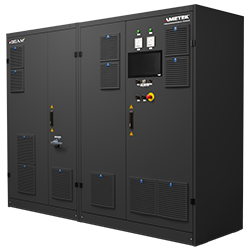
i-BEAM Series
Voltage: 5 V to 1,500 V
Current: Up to ±1,200 A per system; up to ±2,400 A in parallel
Power: Up to 650 kW per system; parallel configurations scalable up to 5 MW
Overview: High-performance, bidirectional, regenerative programmable DC power system, battery cycler and simulator
Current: Up to ±1,200 A per system; up to ±2,400 A in parallel
Power: Up to 650 kW per system; parallel configurations scalable up to 5 MW
Overview: High-performance, bidirectional, regenerative programmable DC power system, battery cycler and simulator
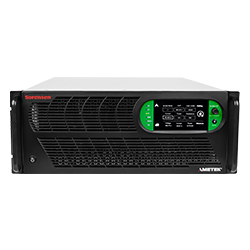
Mi-BEAM Series
Voltage: 80 V to 2,000 V
Current: Up to ±1,000 A per unit
Power: 10 kW to 37.5 kW per unit; scalable up to 8.6 MW+ through parallel operation
Overview: High-performance, modular, bidirectional, regenerative programmable DC power system, battery cycler and simulator
Current: Up to ±1,000 A per unit
Power: 10 kW to 37.5 kW per unit; scalable up to 8.6 MW+ through parallel operation
Overview: High-performance, modular, bidirectional, regenerative programmable DC power system, battery cycler and simulator
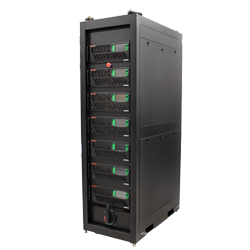
Mi-BEAM Power Rack Series
Voltage: 80 V to 2,000 V
Current: Up to ±7,000 A per rack
Power: Up to 262.5 kW per rack; scalable up to 8.6 MW+ through parallel operation
Overview: Integrated, modular, bidirectional regenerative DC power rack for high-power source and load testing
Current: Up to ±7,000 A per rack
Power: Up to 262.5 kW per rack; scalable up to 8.6 MW+ through parallel operation
Overview: Integrated, modular, bidirectional regenerative DC power rack for high-power source and load testing
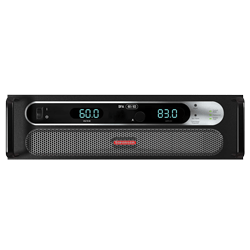
SFA Series
High Slew Rate DC Current Source
Voltage: 60V - 160VCurrent: 31A - 500A
Power: 5kW - 30kW
Overview: High Slew Rate Current Source

SGA Series
High Power Modular DC Supplies
Voltage: 10V - 1000VCurrent: 5A - 6000A
Power: 4kW - 150kW
Overview: High Power Modular DC Power Supplies
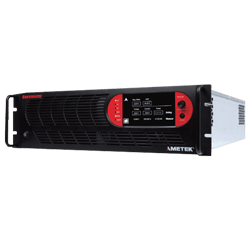
SGX Series
High Power Modular DC Supplies
Voltage: 10V - 1000VPower: 5 kW to 30 kW per chassis and up to 975 kW through parallel operation
Overview: High Power Modular DC Power Supplies

XFR Series
Sorensen Analog DC Power Supplies
Voltage: 7.5V - 600VCurrent: 4A - 300A
Power: 2.8kW
Overview: Programmable Analog DC Power Supplies
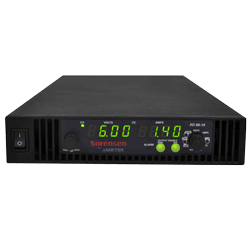
XG 850
Sorensen 1U Half-Rack DC Power Supply
Voltage: 6V - 600VCurrent: 1A - 110A
Power: 670W - 850W
Overview: Full & 1/2 Rack Programmable DC Power Supplies
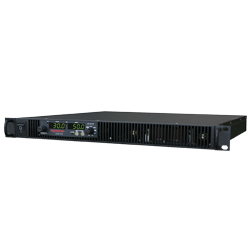
XG 1500
Sorensen 1U Rack DC Power Supply
Voltage: 6V - 600VCurrent: 2A - 187A
Power: 1500W - 1560W
Overview: 1500 Watt, 1U Programmable DC Power Supplies
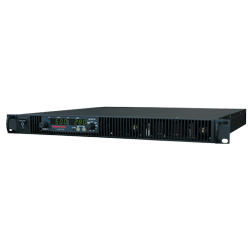
XG 1700
Sorensen 1U Rack DC Power Supply
Voltage: 6V - 600VCurrent: 2A - 220A
Power: 1330W - 1710W
Overview: 1700 Watt, 1U Programmable DC Power Supplies
Frequently Asked Questions
Click on any question below to expand its answer!
-
What is a DC power supply?A DC power supply typically takes the AC power from a wall outlet and converts it into a DC voltage. This direct current (DC) is then used to run everyday electronic devices, circuits, or components such as your cell phone and computer.
DC power supplies come in many types and sizes, offering different voltage levels, current capacities, and power ratings depending on the application. -
What’s the difference between adjustable, variable, and programmable DC power supplies?
A variable DC power supply lets you adjust the output voltage and current as needed, typically with set screws or potentiometers that require some sort of tool.
An adjustable DC power supply is similar to a variable one. It allows users to manually change the voltage and current settings, typically using knobs, dials, or digital controls. It’s a great tool for engineers and technicians working with multiple devices that need different power levels.
Difference Between Adjustable, Variable, and Programmable DC Power Supplies
- Adjustable/Variable: Usually manually controlled via knobs, buttons or set screws and trim potentiometers.
- Programmable: Controlled through software, interfaces, or automation systems. They allow precise settings, remote control, and repeatable test setups—ideal for advanced or automated applications.
- Adjustable/Variable: Usually manually controlled via knobs, buttons or set screws and trim potentiometers.
-
Why do I need a DC power supply?DC power supplies are essential when your device or circuit requires a constant, stable voltage or current to operate correctly. They are widely used in testing labs, product development, electronics servicing, and more.
-
What is the difference between a converter and inverter?A converter typically refers to an electronic device that takes AC energy and converts it into DC energy. For example, your cell phone and laptop all utilize a converter that takes the AC energy from the wall outlet and converts it to DC.
The opposite is true for an inverter, which takes AC energy and turns it into DC energy with an example being what is used to take solar panel energy and put it back onto the grid in your house. -
Linear vs. Switching DC power supply – which is better?
It depends on your application:
- Linear power supplies are quieter and better for sensitive analog work.
- Switching power supplies are lighter, more efficient, and better for high-power or portable applications. Modern switching designs have significantly improved in terms of noise performance.
-
What is transient response in a DC power supply?Transient response measures how quickly and accurately a power supply reacts to sudden changes in load. A good transient response ensures your supply can handle varying demands without affecting performance or stability.
-
What is slew rate?Slew rate refers to how fast the DC output can rise or fall when adjusted. It's influenced by internal components like capacitors and the energy demand of the connected device. A higher slew rate means quicker response time and slew can be used for a number of parameters such as voltage, current, power and resistance.
-
What is load regulation?Load regulation indicates how much the output voltage changes when the connected device (load) draws more or less current. A high-quality power supply maintains a steady voltage, even when load conditions vary.
-
What is line regulation?Line regulation describes how stable the output voltage stays when the AC input voltage fluctuates. A well-designed supply compensates for these changes and delivers consistent performance.
-
What is stability in programmable DC power supplies?Stability refers to how much the output voltage or current drifts over time. It’s often measured in parts per million (ppm). Good long-term stability is important for precision testing or long-duration experiments.
-
How do I choose the right DC power supply for my needs?
Start by knowing your voltage, current, and power requirements. Then consider:
- Linear vs. switching type
- Precision and stability
- Manual vs. programmable control
- Size, efficiency, and cooling
- Safety features and ease of use
Choosing the right model ensures reliability and saves time during setup and operation.
-
What power ranges do Sorensen DC power supplies offer?Sorensen, a brand by AMETEK Programmable Power, offers a wide range of reliable DC power supplies—ideal for everything from lab testing to industrial use. Power levels range from 30 watts to 650 kilowatts, with options to scale up to 1.3 megawatts using parallel configurations.