



Terrestrial PV Simulators
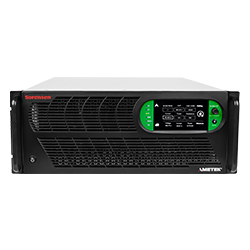
AMETEK Programmable Power’s Mi-BEAM and ETS platforms deliver advanced PV simulators designed for accurate testing solar inverters and hybrid energy systems.
These programmable DC sources emulate real-world photo-voltaic panel outputs, enabling precise control of I-V curves, irradiance levels, and dynamic load conditions without the need for physical PV arrays.
Designed for high-performance R&D and production environments, these systems support validation of MPPT algorithms, inverter efficiency, and fault response across a wide range of voltage and power levels. Their flexibility and accuracy make them ideal for accelerating development in solar, microgrid, and renewable energy applications.
Frequently Asked Questions
-
What are terrestrial PV simulators?
Terrestrial PV simulators are programmable power systems that emulate real-world photovoltaic array output so engineers can test solar inverters and energy systems without physical PV panels. They reproduce PV electrical behavior using controlled I-V curves, irradiance levels, and dynamic operating conditions for repeatable lab and production testing.
-
What are terrestrial PV simulators used for?
Terrestrial PV simulators are used for solar inverter testing, MPPT validation, and hybrid energy system testing in R&D and production environments. They support test scenarios such as inverter efficiency evaluation and response testing under programmable PV conditions.
-
How do PV simulators work without real PV panels?
PV simulators work by using a programmable DC source to simulate PV panels. This enables repeatable, automated testing by controlling I-V curves, irradiance-related output changes, and dynamic operating conditions without relying on sunlight or physical modules.
-
How do PV simulators support solar inverter testing?
PV simulators support solar inverter testing by providing engineers with precise control over input voltage, current, power levels, and I‑V curve conditions while evaluating inverter operation. This allows validation of inverter startup behavior, MPPT algorithms, conversion efficiency, protection functions, grid-interaction response, and fault scenarios under controlled laboratory conditions. Unlike field testing, engineers can repeatedly execute the same test profiles and compare inverter performance across identical operating conditions.
-
Which PV simulators are available from AMETEK Programmable Power?
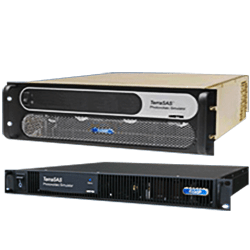
AMETEK Programmable Power offers terrestrial PV simulator solutions through the Mi‑BEAM and TerraSAS (ETS Series). These platforms are positioned for inverter and hybrid energy testing using controllable PV behavior such as I-V curve shaping and dynamic conditions.
-
How do PV simulators emulate real-world I-V curves and irradiance changes?
PV simulators emulate PV behavior by using a highly programmable DC source to generate I-V curves and adjust output to represent changing irradiance and operating conditions. The quality of a PV simulator depends in part on how accurately and dynamically the source can be programmed to reproduce the electrical behavior of a real PV array.
-
Can terrestrial PV simulators help validate MPPT performance?
Yes - terrestrial PV simulators are commonly used to validate Maximum Power Point Tracking (MPPT) algorithms by exposing inverters to controlled PV conditions that can change quickly and repeatably. TerraSAS (ETS Series) is designed to keep up with advanced MPPT behavior using low output capacitance and high closed-loop bandwidth for grid-tied inverter testing.
-
What is TerraSAS (ETS Series), and when should I use it?
TerraSAS (ETS Series) is a standalone terrestrial PV simulator designed to emulate the dynamic electrical behavior of terrestrial PV solar arrays for inverter and microgrid-related test applications. It combines an agile power supply with an I-V curve generator and is a strong fit when realistic PV dynamics and MPPT-related response speed are required.
-
What is Mi-BEAM used for in terrestrial PV simulator applications?
Mi-BEAM is a modular, high-power programmable DC platform used in advanced energy testing, including terrestrial PV simulator applications. It is part of AMETEK's PV solution set for inverter and hybrid energy testing across wide voltage and power levels.
-
Are AMETEK PV simulators suitable for microgrid and hybrid energy system testing?
Yes - AMETEK PV simulator platforms support hybrid energy, inverter, and microgrid-related testing by combining programmable output control with realistic PV source behavior. TerraSAS is well suited for applications that require fast, accurate PV dynamics, while Mi-BEAM supports scalable, high-power testing for larger energy systems.
-
Why is I-V curve control important in a PV simulator?
I-V curve control is important because inverters and MPPT algorithms respond to the PV source's electrical characteristics, not just a fixed DC voltage. Accurate I-V curve control helps create realistic PV operating conditions to evaluate inverter tracking and performance behavior.
-
What does irradiance control mean in a PV simulator?
Irradiance control means adjusting the simulator output to represent changing sunlight conditions. This allows engineers to evaluate inverter and hybrid energy system behavior across controlled PV operating scenarios.
-
Why do microinverters and grid-tied inverters need dynamic PV simulator behavior?
Microinverters and grid-tied inverters often use fast response techniques to track the maximum power point, which requires the PV source to behave realistically at relevant ripple and dynamic frequencies. TerraSAS supports advanced MPPT testing through realistic PV voltage/current behavior, while Mi-BEAM provides scalable high-power capability for larger inverter and energy system applications.
-
What is low output capacitance, and why does it matter for terrestrial PV simulators?
Low output capacitance helps a terrestrial PV simulator behave more like a real PV source for certain inverter control and MPPT methods. It allows the device under test to experience power more accurately, with less delay or distortion than sources with higher output capacitance. TerraSAS uses low output capacitance and high bandwidth to keep up with advanced MPPT behavior in grid-tied inverter testing.
-
How do I choose the right terrestrial PV simulator for my application?
Start with your inverter type, required voltage and power, and how realistically you need to reproduce PV dynamics for MPPT behavior. TerraSAS is a dedicated terrestrial PV simulator optimized for inverter dynamics, while Mi-BEAM is a scalable platform that supports PV simulator use cases as part of broader high-power testing.
👉 Contact Us | Request a Quote