



Battery Simulators
AMETEK Programmable Power’s Mi-BEAM, i-BEAM, and BSS Series offer advanced battery simulators for testing and validating battery-powered systems without the need for physical batteries.
These programmable DC power systems emulate a wide range of battery chemistries and behaviors, enabling precise control over voltage, current, and internal resistance to replicate real-world conditions such as state-of-charge, voltage sag, and thermal effects.
Designed for high-performance applications, Mi-BEAM and i-BEAM support development and validation of battery management systems (BMS), power converters, and electric drivetrains across automotive, aerospace, industrial, and defense sectors. Their bidirectional and regenerative architecture ensures efficient, repeatable testing in both R&D and production environments.
The Elgar Battery String Simulators (BSS) provide safe, reliable battery power for spacecraft testing. The broad range of features available ensures simulation capabilities for more than just two terminal power. It's the ideal solution for complete integrated system testing, not just battery elimination.
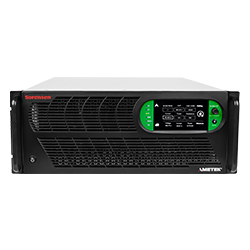
Mi-BEAM Series
Current: up to 1000 A
Power: 10 kW to 37.5 kW, scalable up to 8.6 MW+
Overview: High Performance, Modular Bidirectional, Regenerative, Programmable DC Power System
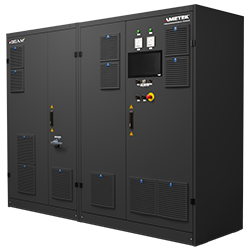
i-BEAM Series
Current: ±1,000 A; Parallel up to ±2,000 A
Power: Single system power up to 650 kW; Parallel system power up to 1.3 MW
Overview: High Performance, Bidirectional, Regenerative, Programmable DC Power System
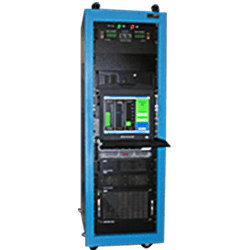
Battery String Simulator (BSS)
Frequently Asked Questions
-
What is battery simulation?
Battery simulation is testing battery-powered systems without physical batteries by emulating battery behavior using a programmable DC system. It enables control of voltage, current, and internal resistance to reproduce real-world conditions like state-of-charge (SoC) and voltage sag.
-
What is a battery simulator / battery emulator?
A battery simulator (battery emulator) is a programmable source/sink that reproduces battery voltage and current for repeatable testing. It can model battery behavior such as internal resistance/ESR and SoC/SoH-like conditions without needing real cells.
-
What is a battery simulator power supply?
A “battery simulator power supply” is typically a bidirectional programmable DC power supply used to emulate both discharge and charge behavior. AMETEK Programmable Power positions its battery simulation platforms as bidirectional and regenerative for efficient, repeatable testing.
-
What does AMETEK Programmable Power offer for battery simulation?
AMETEK Programmable Power offers battery simulation solutions including Mi‑BEAM, i‑BEAM, and Battery String Simulator (BSS). These platforms are positioned for validating BMS, power converters, and electric drivetrains, and BSS is positioned for spacecraft-related battery simulation.
-
Can battery simulation be used for battery management system (BMS) simulation?
Yes—battery simulation is used to validate battery management systems (BMS) without physical packs. The category positioning highlights use in BMS, converters, and drivetrains testing across industries.
-
Do these solutions support bidirectional testing (charge + discharge)?
Yes—bidirectional capability helps simulate both battery discharge (source) and battery charging (sink) behavior. i‑BEAM and Mi‑BEAM are described as bidirectional and regenerative platforms (model dependent).
-
What is battery cell simulation vs pack simulation?
Battery simulation can scale from cell/module-level to pack/system-level depending on required voltage/current/power. Mi‑BEAM is positioned as modular and scalable, i‑BEAM is positioned for higher-power battery simulation with parallel scalability.
-
What is battery simulation software?
Battery simulation software helps run repeatable test scenarios by applying a battery model and controlling simulator output behavior. Mi‑BEAM is positioned as a “complete solution” that includes battery simulation capability and related resources (drivers/software sections vary by product page).
-
What automation interfaces are available for integration?
Battery simulation platforms often provide interfaces for automation and test stand integration. i‑BEAM lists options such as Ethernet/VNC, Modbus, CAN, EtherCAT, Profinet, plus integration workflows with LabVIEW and MATLAB/Simulink.
-
What is the Battery String Simulator (BSS) used for?
The Battery String Simulator (BSS) is positioned to provide safe, reliable battery power for spacecraft testing and integrated system testing. BSS is described with static and dynamic modes, spreadsheet-based charge tables, and optional sensor simulation for more complete emulation.
👉 Request a Quote | Talk to an Engineer -
What battery behaviors can be emulated (SoC, voltage sag, internal resistance)?
Battery simulators emulate battery behavior by controlling voltage, current, and internal resistance to reproduce real operating conditions without physical cells. This supports repeatable testing across modeled conditions like SoC and load-driven voltage sag, AMETEK Programmable Power describes emulation of behaviors including SoC and voltage sag via controlled parameters.
-
Why is internal resistance/ESR important in battery emulation?
Internal resistance/ESR impacts terminal voltage under load and charge current, so modeling is key for realistic battery simulation. Without ESR modeling, tests may miss real behaviors like voltage sag, and charger/BMS edge conditions; AMETEK’s definition includes internal resistance/ESR reproduction.
-
What does “regenerative” battery simulation mean and why does it matter?
Regenerative battery simulation means the system can sink power during charge simulation and return absorbed energy instead of dissipating it as heat, improving efficiency for long tests. AMETEK Programmable Power describes i‑BEAM as regenerative (up to ~96%) and Mi‑BEAM as regenerative (up to ~95%), supporting efficient, repeatable testing.
-
How do I choose Mi‑BEAM vs i‑BEAM for battery simulation?
Choose based on required voltage/current/power and integration needs: Mi‑BEAM is positioned as modular bidirectional/regenerative, while i‑BEAM targets higher power with extensive industrial controls. i‑BEAM is described with scaling to 650 kW single and 1.3 MW parallel, and lists interfaces such as Modbus/CAN/EtherCAT/Profinet and LabVIEW/MATLAB integration.
👉 Request a Quote | Contact Us -
Does battery simulation support drive-cycle or dynamic waveform testing?
Many battery test workflows require dynamic profiles (changing voltage/current over time) to match real operating conditions more accurately than a static power source. i‑BEAM is positioned for advanced, integration-heavy test workflows.
-
Can I integrate battery simulation into HIL setups (BMS HIL)?
Yes—battery simulation is widely used for BMS validation, including integration-heavy test setups. i‑BEAM lists HIL-relevant interfaces such as CAN, EtherCAT, Profinet, plus integration workflows using LabVIEW and MATLAB/Simulink.
-
What makes BSS suitable for spacecraft battery string emulation (beyond two-terminal power)?
Battery String Simulator (BSS) is positioned for spacecraft battery simulation, enabling integrated system testing beyond basic two-terminal power behavior. BSS is described with static/dynamic modes, spreadsheet-based charge tables, optional sensor simulators (e.g., thermistor/pressure/heater loads), and remote control via Ethernet/optional GPIB using SCPI format commands.