



Battery Cyclers
AMETEK Programmable Power’s Mi-BEAM and i-BEAM Series deliver high-performance battery cycling solutions for demanding energy storage applications. With full bidirectional DC source and sink capabilities, these systems enable precise charge/discharge testing, lifecycle analysis, and performance validation across a wide range of battery chemistries. Their regenerative design supports energy recovery up to 96%, making them ideal for R&D, production, and qualification testing in EV, aerospace, industrial, and defense sectors.
Mi-BEAM offers modular scalability up to 8.6MW+ and 231kA, while i-BEAM supports applications up to 1.3MW and 2.4kA. Both platforms feature advanced programmability, multi-channel configurations, and seamless transitions between source and sink modes. Whether you're testing individual cells or full battery packs, Mi-BEAM and i-BEAM provide the precision, flexibility, and efficiency needed to accelerate development and ensure reliability.
Need help determining which DC power supply is right for you?
Download the Guide: Selecting the Right Programmable Power Solution.This comprehensive guide will detail modern advancements in power supplies, the importance of power systems, and how to get the right solution based on your specific application.
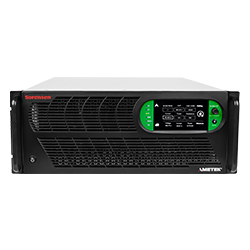
Mi-BEAM Series
Current: up to 1000 A
Power: 10 kW to 37.5 kW, scalable up to 8.6 MW+
Overview: High Performance, Modular Bidirectional, Regenerative, Programmable DC Power System
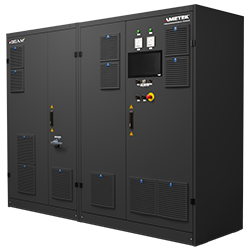
i-BEAM Series
Current: ±1,000 A; Parallel up to ±2,000 A
Power: Single system power up to 650 kW; Parallel system power up to 1.3 MW
Overview: High Performance, Bidirectional, Regenerative, Programmable DC Power System
Frequently Asked Questions
-
What is a battery cycler?
A battery cycler is test equipment that performs repeated charge/discharge cycles to characterize battery performance, efficiency, and lifespan. Modern cycling is commonly done with bidirectional DC source/sink systems that charge and discharge while monitoring test parameters over time.
-
What is a battery cycling test?
A battery cycling test is repeated charging and discharging used to evaluate cycle life, capacity/efficiency trends, and performance validation under controlled conditions. Typical setups can use programmable power supplies and loads (or integrated systems) plus automation/data logging across many cycles.
-
Who is a battery cycler supplier for EV and R&D?
AMETEK Programmable Powerprovides battery cycler solutions through the Mi-BEAM and i-BEAM series platforms. Their battery cycler category page positions these as bidirectional source/sink systems for lifecycle analysis and validation, and highlights regenerative energy recovery up to 96%.
👉 Request a Quote -
What is a battery cell cycler vs. a battery pack cycler?
A battery cell cycler is typically used for smaller DUTs (cells/modules), while a battery pack cycler is designed for higher voltage/current pack-level testing. Pack-level cycling commonly benefits from regenerative bidirectional systems to reduce wasted discharge energy and cooling load in high-power labs.
-
What is a battery cycler system used for?
A battery cycler system is used for charge/discharge testing, lifecycle analysis, and qualification of energy storage systems. AMETEK Programmable Power highlights bidirectional operation and seamless transitions between source and sink modes for cycling workflows.
-
Why is bidirectional operation important for cyclers for battery testing?
Bidirectional operation allows one platform to both charge (source) and discharge (sink) a battery without switching instruments. In regenerative designs, discharge energy can be returned to the AC grid rather than dissipated as heat, improving lab efficiency and cost.
-
What is an EV battery cycler?
An EV battery cycler is cycling test equipment designed for higher power and pack-level test needs in electric vehicle development and validation. AMETEK Programmable Power positions Mi‑BEAM and i‑BEAM for EV and other demanding sectors, emphasizing regenerative bidirectional cycling for efficient testing.
-
Do AMETEK battery cyclers support high voltage battery cycler needs?
Yes - AMETEK Programmable Power lists Mi‑BEAM with voltage up to 2,000 V, and the i‑BEAM battery cycler page lists voltage up to 1,500 V (model/config dependent). High-voltage battery cycling commonly uses bidirectional regenerative architectures to manage charge/discharge energy efficiently.
-
What is a regenerative battery pack test system?
A regenerative battery pack test system recovers energy during discharge and returns it to the grid instead of wasting it as heat. AMETEK’s Battery Cycler category highlights regenerative energy recovery up to 96% as part of its cycling solution positioning.
-
How do I choose between Mi‑BEAM and i‑BEAM for battery cycling?
Choose based on required power/current: AMETEK positions Mi-BEAM as scalable up to 1.2 MW, while i-BEAM supports high current cycling up to ±2,400 A and power up to 1.3 MW. i‑BEAM also lists extensive control/integration options and regenerative operation up to 96%, supporting advanced test environments.
👉 Request a Quote | Talk to an Engineer -
What parameters are measured during battery cycling tests?
Battery cycling tests typically track voltage, current, and performance change over repeated cycles to evaluate degradation and reliability. Cycling methods often include defined charge/discharge sequences (e.g., CC/CV approaches) and automated logging for capacity/efficiency analysis.
-
Why does regenerative cycling reduce operating costs?
Regenerative cycling reduces cost because discharge energy is recovered and returned to the grid, lowering electricity consumption and cooling requirements. AMETEK Programmable Power’s battery cycler category calls out energy recovery up to 96%, reinforcing the energy-efficiency benefit.
-
What makes a high voltage battery cycler different from lab-scale cyclers?
A high-voltage battery cycler supports higher pack voltages and power levels for EV pack and system-level testing. Industry descriptions of HV cyclers commonly emphasize regenerative bidirectional source/load capability and modular scaling for high-power labs.
-
How does a bidirectional cycler replace separate power supply + electronic load?
A bidirectional cycler can switch between source (charge) and sink (discharge) modes in one unit, eliminating reconnection and multiple instruments. Absorbed discharge energy is often regenerated back to the AC grid, enabling more efficient cycling workflows.
-
What automation and integration options matter for battery cycler systems?
Automation matters for repeatable profiles, long-run stability, and integration into production or qualification test stands. i‑BEAM lists integration/control options such as VNC over Ethernet, Modbus, CAN, EtherCAT, Profinet, LabVIEW, and MATLAB/Simulink, which are useful for advanced test environments.
-
Can AMETEK battery cyclers scale to MW-class and high-current labs?
Yes - AMETEK positions Mi‑BEAM as scalable up to 1.2 MW and i‑BEAM up to 1.3 MW, with i‑BEAM supporting cycling current up to ±2,400 A (as described on their battery cycler pages). i‑BEAM describes parallel scalability, bidirectional cycling, and regenerative efficiency up to 96% for high-power cycling environments.
-
What test environments is AMETEK positioning battery cyclers for?
AMETEK Programmable Power positions battery cyclers for R&D, production, and qualification testing. Their category page explicitly mentions use in EV, aerospace, industrial, and defense, supported by bidirectional and regenerative cycling design.