



AI Data Center Power Testing & Validation
Artificial intelligence is rewriting the rules of data center power. As AI compute clusters push rack densities from tens of kilowatts toward 100 kW and beyond, the industry is transitioning to 800 V DC distribution, solid-state transformers (SSTs), high-voltage power shelves, and battery backup units (BBUs) that must all work together under extreme, fast-changing loads. Before any of this hardware reaches a live facility, it must be validated under realistic high-voltage, high-dynamic conditions.
AMETEK Programmable Power helps qualification teams, lab managers, and power-electronics engineers de-risk this transition. Our Sequoia Series regenerative AC grid simulators, i-BEAM Series high-performance bidirectional regenerative DC power systems, and Mi-BEAM Series modular bidirectional regenerative DC power systems provide the source, sink, and simulation capability needed to test next-generation data center power subsystems accurately, efficiently, and at scale — while recovering energy instead of dissipating it as heat.
Data Center Power Architecture Trends
The AI build-out is one of the fastest-growing drivers of electrical demand in the world. Hyperscale and colocation operators are re-architecting the entire power chain — from the utility feed to the point-of-load converter on the accelerator board — to deliver more power, more efficiently, into a shrinking physical footprint.
Key shifts reshaping data center power architectures include:
- Higher voltage distribution — moving from 12 V and 48 V distribution toward 800 V DC backbones to reduce conductor losses at high current.
- New conversion topologies — solid-state transformers and HVDC power racks replacing conventional line-frequency transformers.
- Energy storage integration — battery energy storage systems (BESS) and BBUs providing ride-through and load stabilization for volatile AI workloads.
- Extreme rack density — rack-level power climbing past 100 kW, demanding compact, low-loss interconnects and thermal headroom.
- Sustainability pressure — regenerative test equipment that returns energy to the grid, cutting facility energy and cooling costs during long-duration validation.
Each of these shifts introduces new validation challenges that legacy, dissipative test equipment was never designed to handle.
Testing and Validation Challenges
Qualification and test managers responsible for data center power subsystems face a convergence of demanding requirements:
High-voltage, high-power validation
Emulating 800 V DC rail behavior and testing SSTs, power shelves, and HVDC racks requires sources and loads that operate cleanly at system voltage and full power.
Fast, dynamic load transients
AI compute clusters create rapid, large-magnitude load steps. Test systems must reproduce these transients and hold control-loop stability to reveal real-world behavior.
Bidirectional power flow
BESS, BBUs, and modern converters push and pull energy. Validation requires seamless source-to-sink transitions, not one-directional supplies.
Energy, heat, and space costs
Conventional dissipative loads waste energy as heat, driving up HVAC load and consuming valuable lab floor space during continuous testing.
Grid disturbance and compliance testing
Front-end AC/DC stages must be proven against sags, swells, frequency deviations, harmonics, and phase imbalance before deployment.
Scalability from R&D to production
Teams need one platform family that scales from a single-chassis bench setup to megawatt-class system validation without re-tooling.
Regenerative Test Solutions for AI Data Center Power
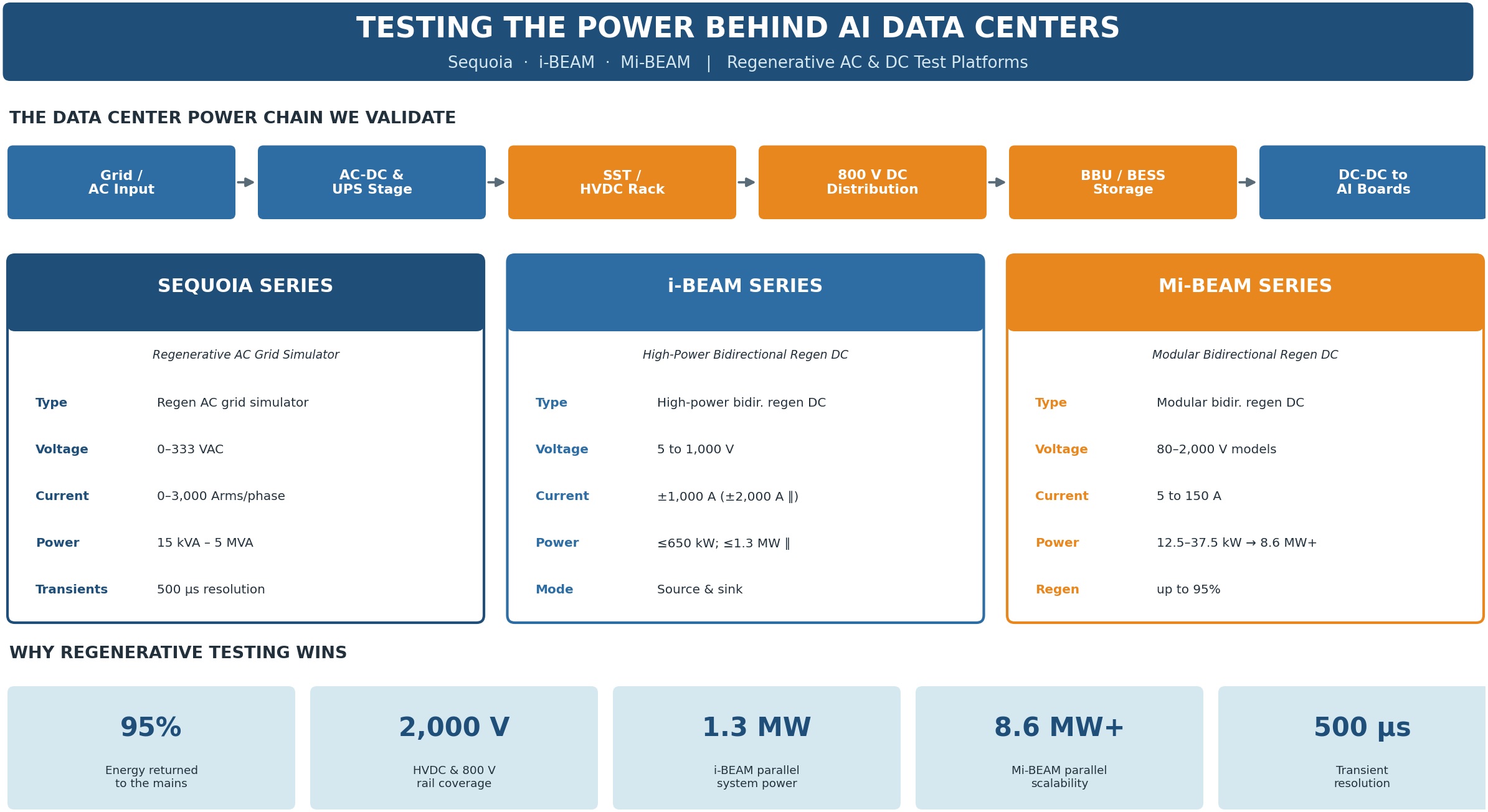
AMETEK Programmable Power delivers three complementary regenerative platforms that together cover the full data center power chain — from grid-facing AC input to high-power DC distribution, battery backup, energy storage, and scalable production validation.
| Specification | Sequoia SeriesRegenerative AC Grid Simulator | i-BEAM SeriesHigh-Power Bidirectional Regen DC | Mi-BEAM SeriesModular Bidirectional Regen DC |
|---|---|---|---|
| Type | Regenerative AC grid simulator | High-performance, bidirectional, regenerative programmable DC power system | High-performance, modular bidirectional, regenerative programmable DC power system |
| Voltage | 0–333 VAC | 5 to 1,000 V | 80, 400, 600, 800, 1200, 1500, up to 2,000 V |
| Current | 0 A to 3,000 Arms/phase | ±1,000 A; parallel up to ±2,000 A | 5 to 150 A |
| Power | 15 kVA to 5 MVA | Up to 650 kW single system; up to 1.3 MW in parallel | 12.5 kW to 37.5 kW; scalable up to 8.6 MW+ in parallel |
| Regeneration | Regenerative (energy returned to mains) | Bidirectional regenerative (source & sink) | Up to 95% energy returned to mains |
| Highlights | Precision programmable grid simulation — sags, swells, frequency deviation, phase imbalance, harmonics; 500 µs transient resolution; grid-interactive AC input validation | High-power source/sink for HVDC, battery, power-shelf and converter validation | Modular scalability for HVDC distribution, BBU/BESS cycling, DC-DC converter testing and production validation |
| Reference | Sequoia Series page | i-BEAM Series page | Mi-BEAM Series page |
Sequoia Series — Regenerative AC Grid Simulator
The California Instruments Sequoia Series is a precision programmable regenerative AC grid simulator designed for realistic utility-grid simulation and disturbance testing. With 0–333 VAC output, 0–3,000 Arms/phase current capability, and scalable power from 15 kVA to 5 MVA, Sequoia validates front-end AC/DC conversion stages, online UPS systems, grid-interactive equipment, and high-power AC input behavior under real-world line conditions.
i-BEAM Series — High-Power Bidirectional, Regenerative DC Power System
The Sorensen i-BEAM Series is a high-performance, bidirectional, regenerative programmable DC power system for high-power source/sink testing. With 5 to 1,000 V output, bidirectional current up to ±1,000 A and parallel operation up to ±2,000 A, i-BEAM supports single-system power up to 650 kW and parallel-system power up to 1.3 MW for demanding HVDC, battery, power-shelf, and converter validation.
Mi-BEAM Series — Bidirectional, Regenerative DC Power System
The Sorensen Mi-BEAM Series is a high-performance, modular bidirectional, regenerative programmable DC power system for scalable DC source/sink testing. With available voltage models of 80, 400, 600, 800, 1200, 1500, and up to 2,000 V, current from 5 to 150 A, and power from 12.5 kW to 37.5 kW per unit, Mi-BEAM scales up to 8.6 MW+ in parallel for HVDC distribution, BBU/BESS cycling, DC-DC converter testing, and production validation.
Benefits for Data Center Power Testing Teams
- Test at system voltage — Sequoia supports 0–333 VAC grid simulation, i-BEAM supports 5 to 1,000 V DC high-power bidirectional testing, and Mi-BEAM supports 80 V through 2,000 V modular DC validation for modern 800 V DC and HVDC architectures.
- True bidirectional capability — Four-quadrant AC and bidirectional DC operation reproduce the push-pull energy flows of BESS, BBUs, and modern converters.
- Energy recovery, not heat — Regeneration up to 95% returns energy to the mains, cutting electricity use, heat, and HVAC load during long-duration testing.
- Scalable power coverage — i-BEAM supports single-system power up to 650 kW and parallel systems up to 1.3 MW, while Mi-BEAM scales from 12.5 kW to 37.5 kW per unit and up to 8.6 MW+ in parallel.
- Fast, precise dynamics — Sequoia's 500 µs transient resolution and Mi-BEAM's fast transient response reveal control-loop and stability behavior under realistic AI load steps.
- One platform, R&D to production — Both platforms scale from single-chassis bench use to megawatt-class systems, covering R&D, design validation, and production test.
- Complete, ready to automate — Included battery test, simulation, and PV/SAS software plus standard LAN/USB/CAN/RS-232 interfaces streamline ATE integration.
AI Data Center Power Test Applications
The Sequoia, i-BEAM, and Mi-BEAM platforms map directly to the critical test points in an AI data center power architecture.
| Application | Recommended Platform | What It Validates |
|---|---|---|
| Solid-State Transformer (SST) testing | i-BEAM + Mi-BEAM + Sequoia | Efficiency, thermal, EMI and fast transient response of HVDC conversion stages |
| 800 V DC power rail / HVDC rack emulation | i-BEAM or Mi-BEAM | Dynamic load transitions at system voltage with energy recovery |
| Power shelf & PSU validation | i-BEAM or Mi-BEAM | Source/sink behavior, efficiency and protection under dynamic load |
| Battery Energy Storage (BESS) & BBU testing | i-BEAM or Mi-BEAM | Charge/discharge profiles, ramp rates, bidirectional flow, safety limits |
| Front-end AC/DC & online UPS testing | Sequoia Series | Ride-through against sags, swells, frequency deviation and harmonics |
| Grid disturbance & compliance testing | Sequoia Series | Voltage/frequency events and harmonic injection for standards compliance |
| DC-DC / point-of-load converter testing | i-BEAM or Mi-BEAM | Regulation and transient performance feeding AI accelerator boards |
Data Center Power Testing Insights
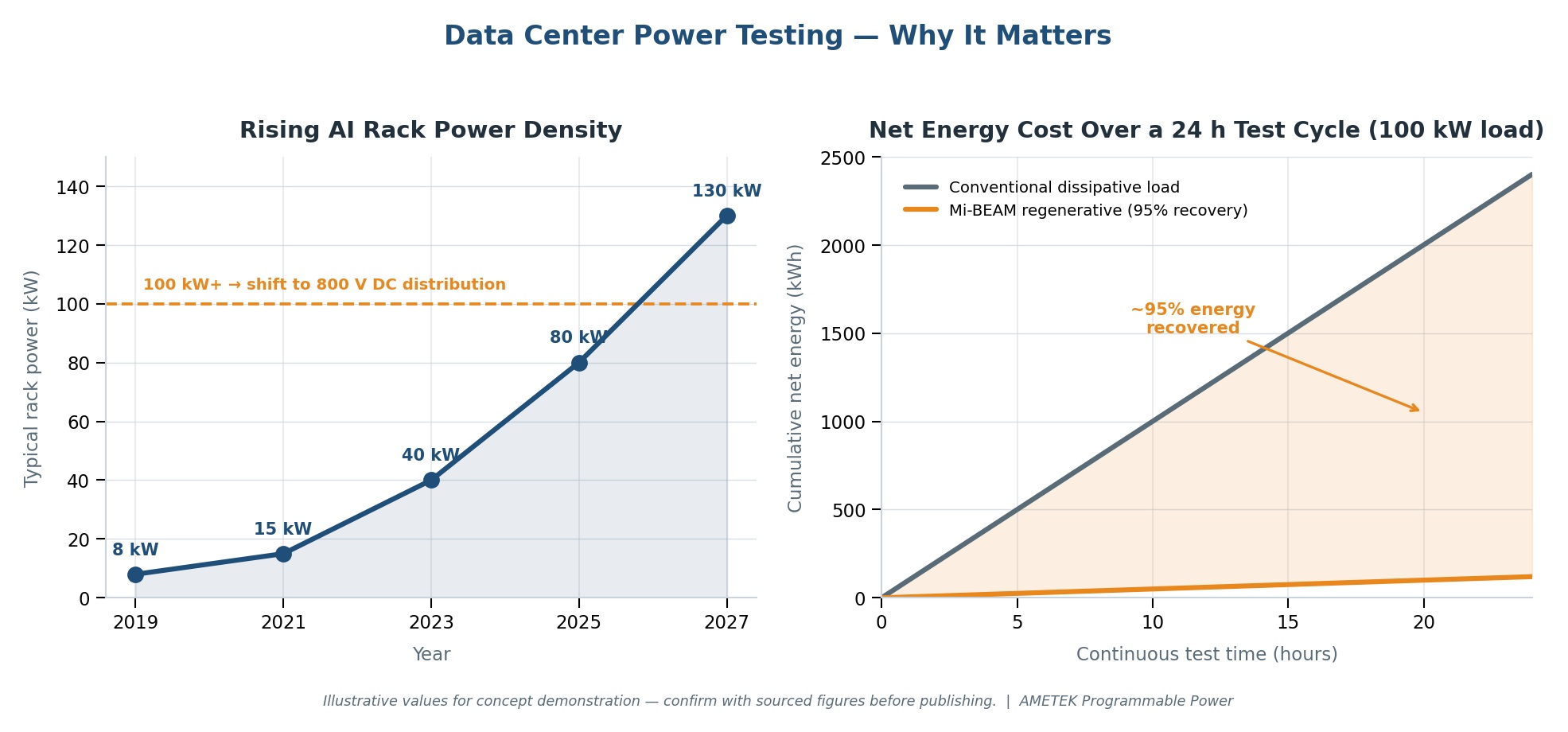
Representative data points that frame the opportunity and the value of regenerative testing (to be confirmed and cited before publishing):
- 100 kW+ racks — Rack power density in AI clusters is climbing past 100 kW, pushing distribution toward 800 V DC backbones.
- 95% energy recovery — Up to ~95% of test energy can be returned to the mains with Mi-BEAM regeneration, versus dissipation as heat in conventional loads.
- High-power DC scalability — i-BEAM supports up to 650 kW in a single system and up to 1.3 MW in parallel, while Mi-BEAM scales up to 8.6 MW+ in parallel for larger DC validation programs.
- Full-chain coverage — Sequoia's regenerative AC grid simulation, i-BEAM's high-power 5 to 1,000 V DC capability, and Mi-BEAM's modular 80 V to 2,000 V DC scalability cover the full AC-to-HVDC data center power chain in one vendor portfolio.
Related Data Center Power Test Solutions
Explore complementary AMETEK Programmable Power platforms and resources relevant to data center power validation: