



Sorensen Electronic Loads
AMETEK Programmable Power provides electronic loads from Sorensen, which boasts the award-winning PLA and PLW Series, the eLOAD line of Air and Water-cooled DC electronic load up to 200kW+, 5000Adc, and 1200Vdc ratings. The Sorensen brand also offers the SL Series of DC electronic loads which provide great value with a flexible platform in a wide range of programmable loads available from 75-1800W with both DC and AC input in benchtop load, modular load, and standalone load.
The SL Series Electronic Load obsolescence was announced on May 22, 2023 with Last Time Buy until November 30, 2023. Please see the PLA Series and PLW Series for replacement products.
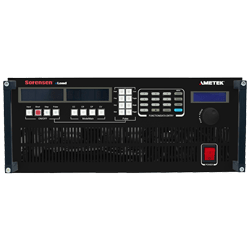
Sorensen PLA Series
Air-cooled Programmable DC Electronic Load
Voltage: 10–1200 VdcCurrent: 10–1500 Adc
Power: 800 W–7.5 kW
Overview: Air-cooled programmable DC electronic load
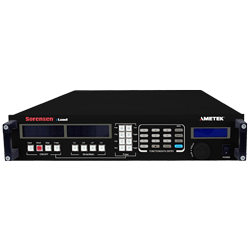
Sorensen PLW Series
Water-cooled Programmable DC Electronic Load
Voltage: 60–1200 VdcCurrent: 10–5000 Adc
Power: 6–250 kW
Overview: Water-cooled programmable DC electronic load
Frequently Asked Questions
-
What is a programmable electronic load?
A programmable electronic load is a testing device used to simulate different electrical loads. Engineers use it to evaluate how power supplies, batteries, or other sources respond under varying conditions. Unlike traditional fixed resistors, a programmable load can dynamically adjust its behavior—absorbing current and power in a controlled and repeatable way. This makes it ideal for testing both steady-state and fast-changing load conditions.
-
What are the typical modes of operation?
Electronic loads can operate in different modes depending on what you need to test:
- Constant Current (CC): Draws a set current regardless of input voltage.
- Constant Voltage (CV): Maintains a specific voltage by adjusting current draw.
- Constant Power (CP): Keeps power consumption constant by automatically adjusting voltage and current.
- Constant Resistance (CR): Simulates a resistive load with a defined resistance.
- Dynamic Mode: Rapidly switches between load levels to test how a power source handles sudden changes.
- Combined Modes (e.g., CC+CV, CR+CV): Useful for simulating more complex load behaviour, especially in modern electronics where multiple conditions exist simultaneously.
-
Why use a programmable electronic load instead of fixed resistors?
Fixed resistors are limited—they offer only one resistance value and can't simulate dynamic load conditions. A programmable load gives engineers much more flexibility. It can mimic real-world load variations, measure key parameters like voltage and current in real time, and help with automated, repeatable testing. This makes it essential for evaluating power supply stability, transient performance, and regulation.
-
Why are electronic loads important for testing?
Modern power systems—from phone batteries to solar inverters—need to be reliable under all conditions. Electronic loads make it possible to simulate real-world scenarios that physical loads like resistors or inductors can't easily replicate. They can quickly shift from low to high loads, apply step changes, or even mimic custom waveforms. This enables precise, efficient performance testing and validation without constant hardware changes.
-
What are some common applications of electronic loads?Power Supply Load Regulation: Used to check if a power supply maintains stable output voltage and current across various load levels.
Battery Discharge Testing: Measures how batteries behave during discharge, typically using constant current mode or pulsed loading.
Automotive ECU Testing: Simulates various resistive loads to verify ECU behavior during functions like braking, acceleration, or autonomous driving.
Fuel Cell Evaluation: Tests how fuel cells perform under varying load conditions, with easy adjustment of current, voltage, and resistance.
-
How do you set basic parameters on an electronic load?
There are four primary ways to configure a programmable load:
- Set Current (CC mode): You specify the current, and the load adjusts voltage accordingly.
- Set Voltage (CV mode): You set the voltage, and the current adjusts to match.
- Set Power (CP mode): The load continuously calculates and adjusts voltage/current to maintain a fixed power level.
- Set Resistance (CR mode): You input a resistance value, and the load calculates the required current to maintain it based on the input voltage.
-
Who typically uses electronic loads?
Electronic loads are widely used by engineers in R&D, testing, and production environments. Industries that commonly use them include:
- Power supply manufacturers
- Battery and charger developers
- Automotive electronics engineers
- Solar and renewable energy system designers
- Aerospace and defense system developers
-
When is a fixed resistor still appropriate?
If you're doing a very simple test and don't need variable or fast-changing loads, a fixed resistor might be enough. But for most modern test scenarios—especially those involving transient loads or closed-loop systems—a programmable electronic load is far more capable and efficient.
-
How do I choose the right electronic load?
Here are key factors to consider:
- Form Factor: Compact, modular units are ideal for scaling up in automated test systems.
- Capacity Ratings: Match the load’s voltage, current, and power ratings to your device under test (DUT).
- Speed: Look for fast slew rates, programmable delays, and rapid response for transient testing.
- Modes: Make sure it supports the modes you need (CC, CV, CP, CR, and dynamic).
- Dynamic Testing: Choose a load with waveform generation (sine, pulse, ramp, etc.) and enough bandwidth and memory for custom profiles.
- Protection: Ensure it has safeguards for overvoltage, overcurrent, overpower, and thermal shutdown.
- Remote Control: Confirm it offers interfaces like USB, LAN, or GPIB for integration with automated setups.
-
What is a DC electronic load?
A DC electronic load is a device designed specifically to test direct current (DC) power sources. It's often programmable and can simulate various load conditions by controlling current, voltage, or power. These are used extensively in industries dealing with batteries, solar panels, fuel cells, and DC-DC converters.
-
What is a DC electronic load used for?
DC loads help manufacturers and engineers test how well a DC power source performs under different operating conditions. They're essential for evaluating battery life, power supply efficiency, solar panel output, fuel cell performance, and more.