



A battery cycler is a precision instrument that executes controlled battery cycling (charge/discharge) to quantify capacity, efficiency, internal resistance/impedance, and derive SoC/SoH. Modern platforms such as i‑BEAM and Mi‑BEAM deliver bidirectional source/sink with regenerative energy recovery, enabling dynamic profiles (e.g., EV drive cycles, BESS duty) from R&D to production.
Why Battery Cyclers Matter?
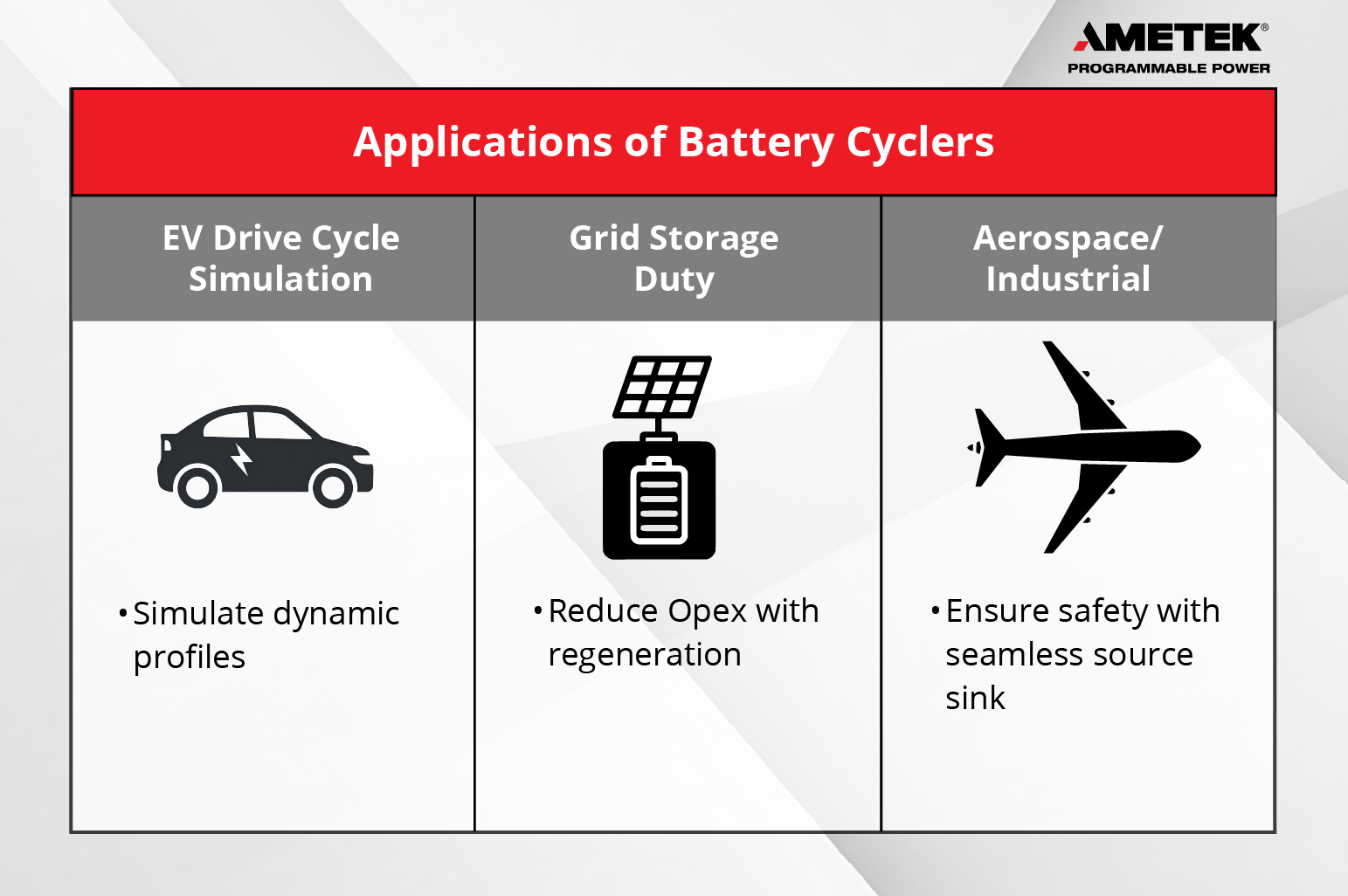
Across EV, aerospace, BESS, and industrial applications, repeated battery cycling reveals capacity fade, internal resistance growth, and efficiency trends under realistic load profiles. These insights guide chemistry selection, pack architecture, thermal strategies, and BMS control while lowering lifecycle risk.
What Does a Battery Cycler Measure?
- Capacity (Ah/Wh): Cycle‑to‑cycle energy; track fade versus baseline.
- Efficiency & Self‑Discharge: Round‑trip energy and idle losses.
- Interrupt or EIS‑assisted analysis of degradation.
- SoC & SoH: Derived from voltage response, capacity, and impedance trends.
- Thermal response: With chamber integration for EV/BESS duty cycles.
How a Battery Cycler Works? (Principles)
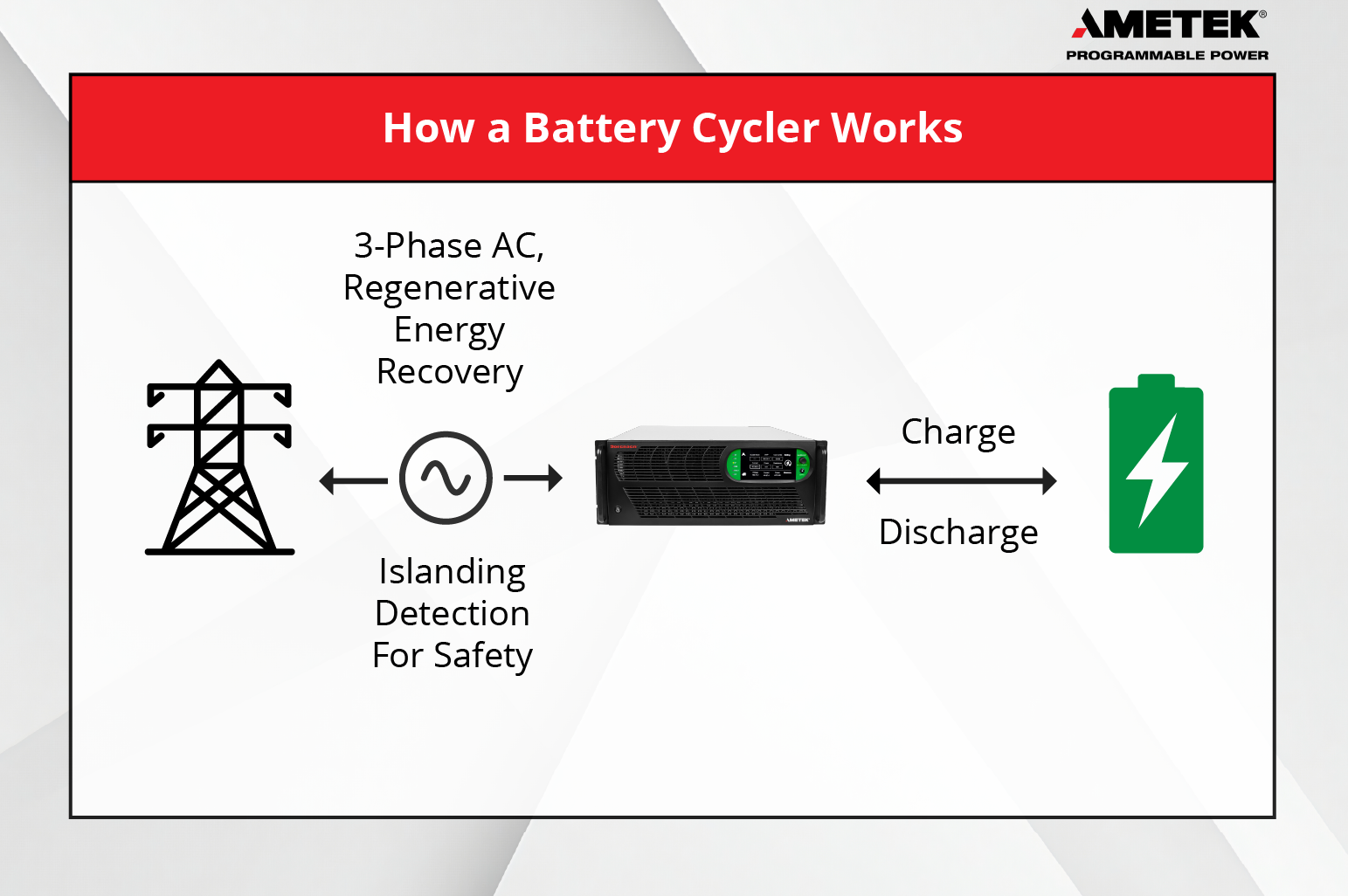
The cycler precisely controls voltage/current to run protocols (e.g., CC‑CV charge, rest, CC discharge) within cut‑offs and safety limits. Advanced systems add bidirectional power (source/sink), regenerative return to grid, autoranging outputs, and rapid, seamless source↔sink transitions for high‑fidelity dynamic testing.
Meet the Platforms: AMETEK i‑BEAM & Mi‑BEAM Battery Cyclers
i‑BEAM Series — High Current, High Power, Multi‑MW Scalability
- Power & Scale: Single system up to 650 kW; parallel up to 1.3 MW; up to ±1,500 A and 1,200 V.
- Bidirectional & Regenerative: Full source/sink with ~96% energy recovery.
- Multi‑channel: 1/2/4 channels sharing internal DC bus; seamless source↔sink.
- Interfaces: VNC/Ethernet, Modbus, CAN, EtherCAT, Profinet, LabVIEW, MATLAB/Simulink, high‑speed analog.
- Safety & UI: 15″ touchscreen, short‑circuit proof, EN ISO 13849‑1; dedicated battery testing/battery simulation modes.
Mi‑BEAM Series — Modular Density, High Voltage (up to 2,000 V), Lab‑Friendly 4U
- Power & Scale: 12–37.5 kW per 4U unit; up to 2,000 V, ±150 A per channel; parallel to ~1.2 MW.
- Bidirectional & Regenerative: ~95% energy recovery; autoranging outputs for versatile protocols.
- Interfaces & Software: LAN, USB, RS‑232, CAN; optional IEEE‑488/EtherCAT; includes battery testing/battery simulation and PV simulator modes.
- Warranty & Usability: 5‑year warranty; color touch UI; seamless source↔sink; built‑in islanding detection.
Choosing the Right Cycler: i‑BEAM vs. Mi‑BEAM (Typical Scenarios)
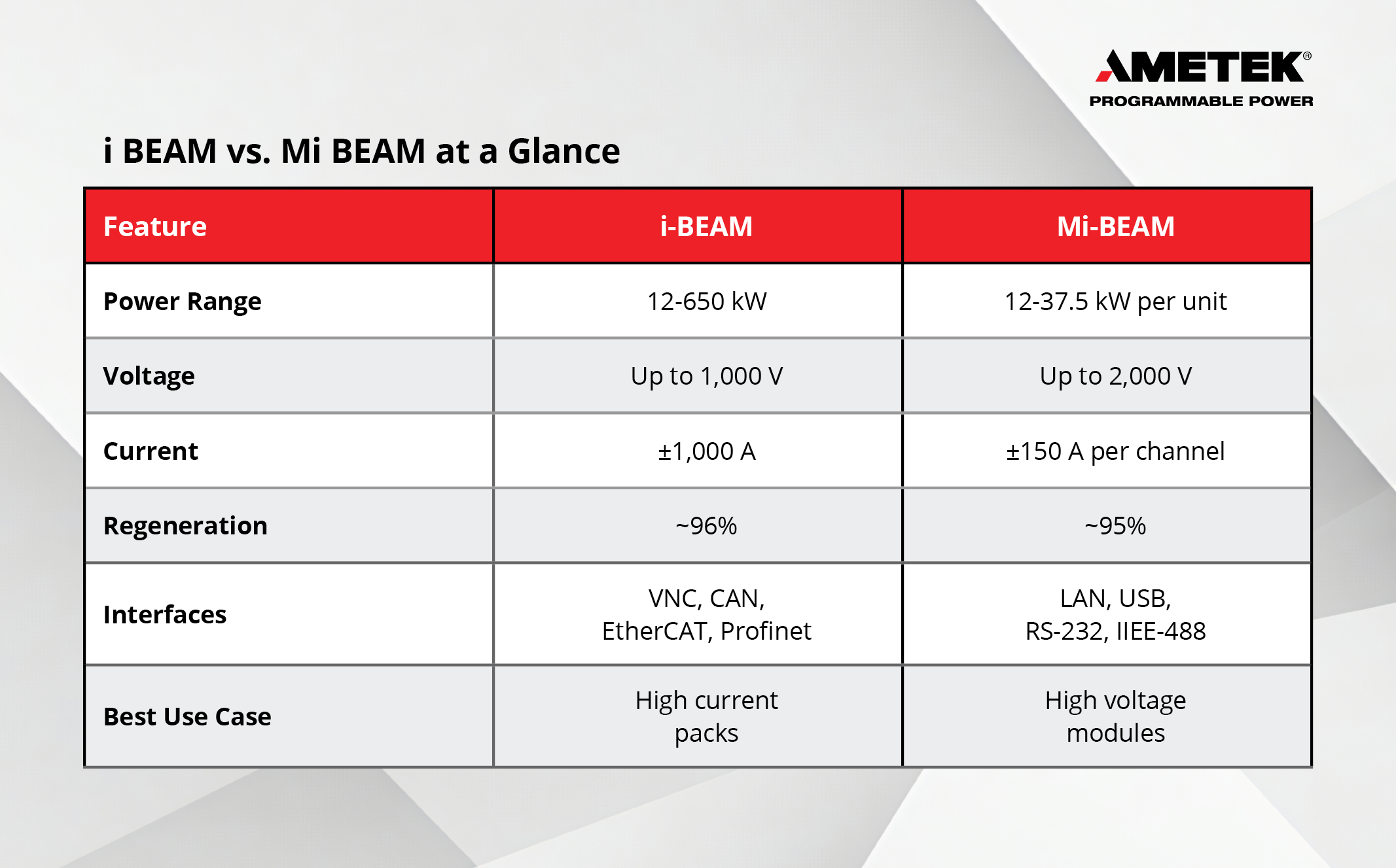
- Pack‑level EV testing / high current pulses → i‑BEAM.
- High voltage module/cell R&D → Mi‑BEAM with autoranging outputs.
- Regenerative energy recovery (Opex reduction) → both platforms (~95–96%).
- Industrial integration → i‑BEAM ; lab‑centric stacks → Mi‑BEAM (standard interfaces).
Example Test Workflows (Implemented on i‑BEAM / Mi‑BEAM)
- Cycle life & capacity fade: CC‑CV → rest → CC; log Ah/Wh, efficiency, ΔR/ΔZ.
- EV drive cycle reproduction: Import current vs. time waveform; enforce cut‑offs.
- Formation & characterization: Low‑rate formation; rate capability sweeps; impedance snapshots.
- BESS duty simulation: Partial SoC cycling; regulation profiles; calendar aging.
Safety, Compliance, and Practical Considerations
Source↔sink transitions; short‑circuit proof; islanding detection; match interfaces to BMS/HIL/PLC (e.g., EtherCAT, Profinet, CAN); coordinate cycler channels with chambers to avoid wasted capacity and ensure software integration.
Frequently Asked Questions (Engineer‑Focused)
What’s the difference between cell, module, and pack cycling?
Cell = lower currents, higher channel counts; Module = moderate currents/voltages with thermal control; Pack = high current transients and BMS interaction. i‑BEAM is ideal for high‑current packs; Mi‑BEAM suits modules/cells.
How does regeneration help my lab?
Regenerative cyclers feed energy back to the grid with ~95–96% energy recovery, reducing heat, cooling load, and electricity usage during long endurance tests.
Which interfaces should I choose?
For industrial automation/HIL: EtherCAT/Profinet/CAN. For R&D scripting: LAN/USB/SCPI, MATLAB/LabVIEW. i‑BEAM offers the broadest fieldbus options; Mi‑BEAM provides lab‑friendly standards.