



A battery simulator (or battery emulator) is a programmable source/sink that reproduces battery voltage, current, and internal resistance/ESR so you can test devices and BMS under realistic SoC/SoH conditions—without physical cells. Modern systems like i‑BEAM and Mi‑BEAM use bidirectional DC power with regenerative energy recovery to emulate charge/discharge and fault scenarios across EV/high voltage applications.
Why Battery Simulation Matters (Accuracy, Safety, Speed)
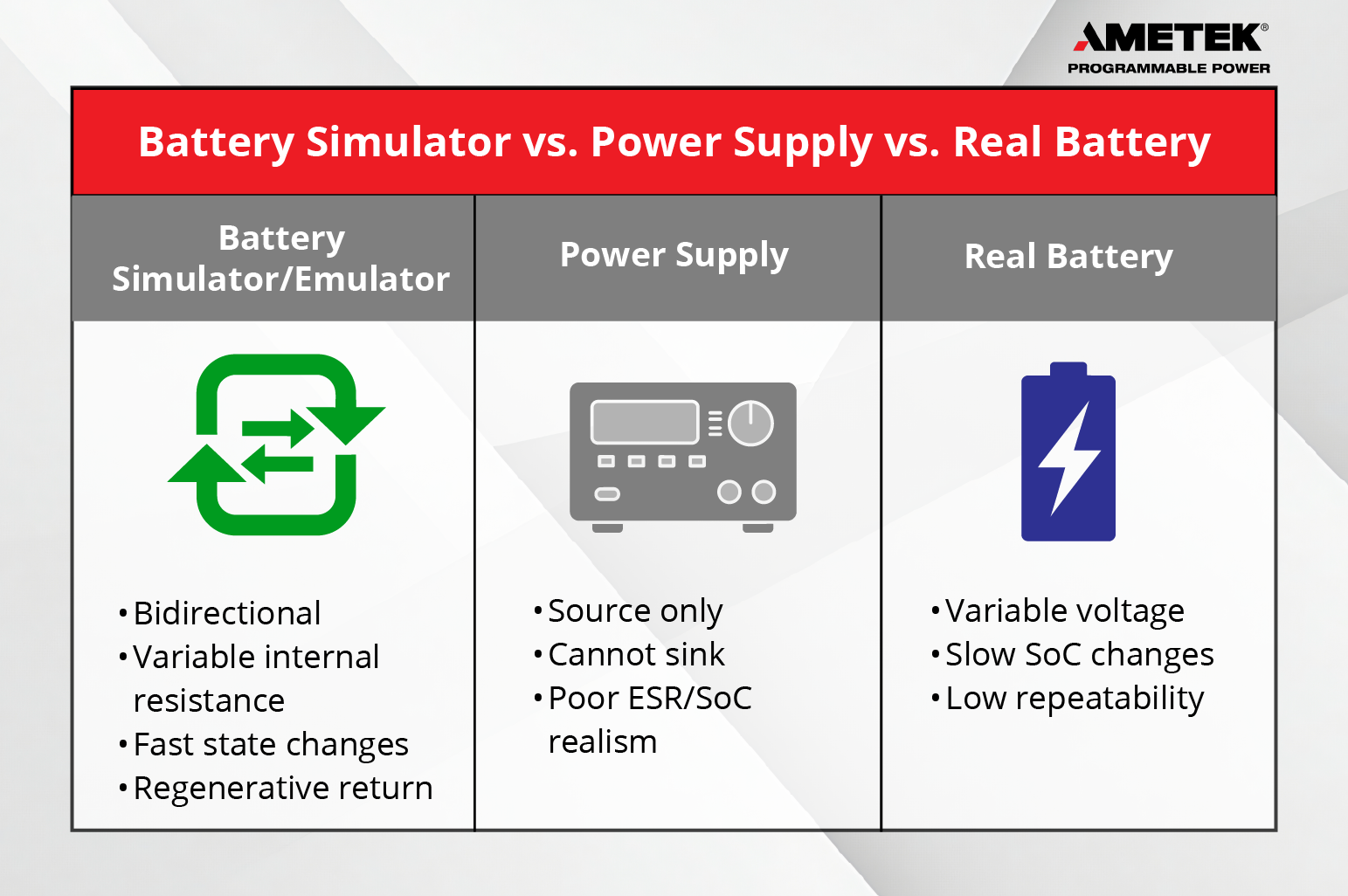
Testing with real batteries is time‑consuming and hard to repeat; battery emulation delivers controlled, repeatable conditions, fast state changes, and safe edge‑case testing (over/under‑charge). It accelerates prototyping, improves measurement repeatability, and reduces Opex via regeneration.
What Does a Battery Simulator Emulate?
- Open‑circuit voltage (VOC) and internal resistance/ESR across SoC/SoH.
- Dynamic I‑V curves and voltage sag under load.
- Charge/discharge profiles and protection logic for chargers (source↔sink).
- Pack/module behavior for BMS HIL and converter testing.
How Battery Emulation Works (Principles)
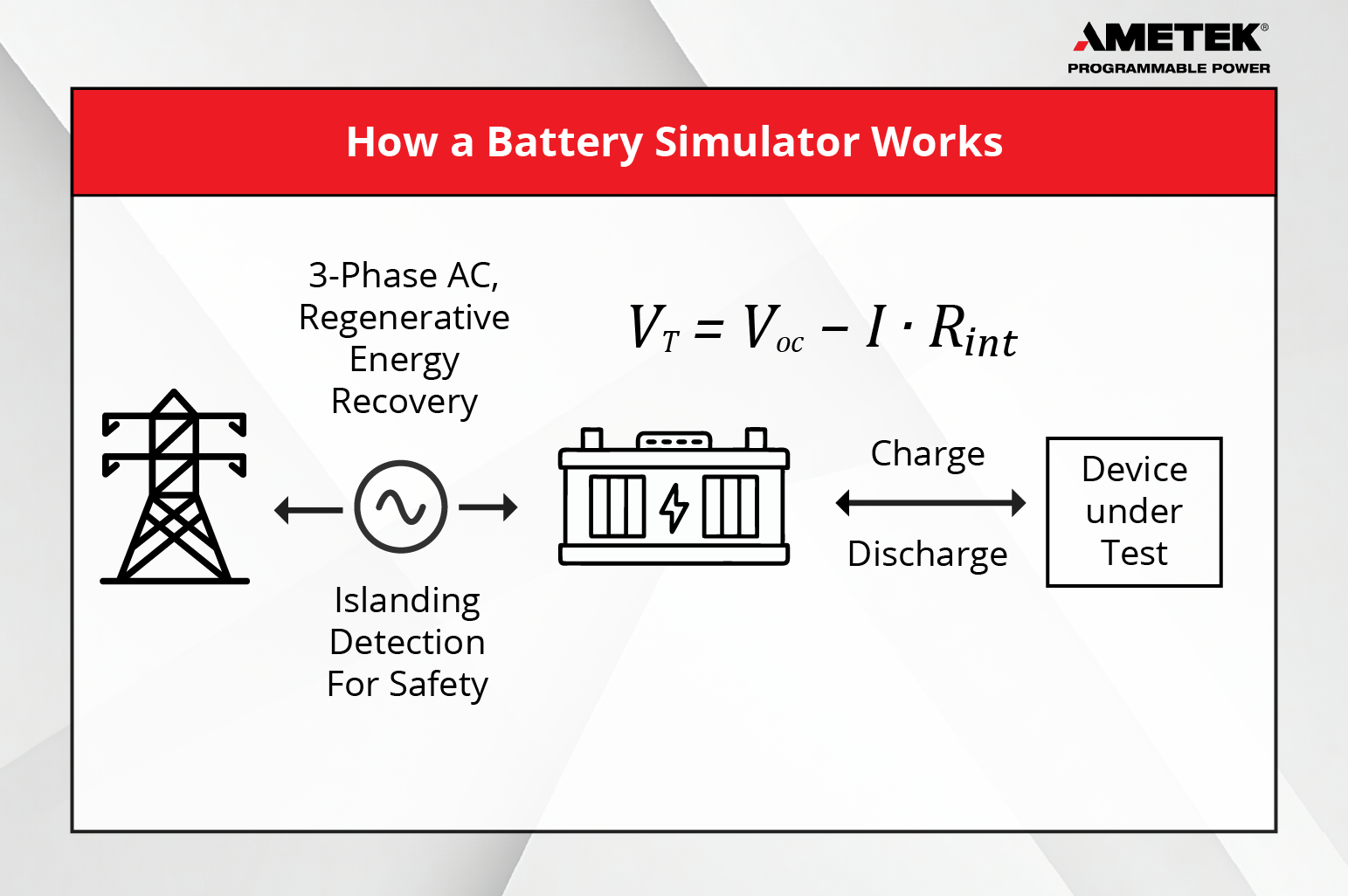
A simulator behaves like a variable voltage source with variable internal resistance: VT = VOC − Iload·Rint. With bidirectional capability, it can source (simulate battery powering a DUT) and sink (simulate battery absorbing charge), often with regenerative return to the grid. Advanced units provide autoranging, fast transients, and seamless source↔sink transitions.
Meet the Platforms: AMETEK i‑BEAM & Mi‑BEAM for Battery Simulation
i‑BEAM — High Current Battery Simulator for Packs and Drivetrains
- Power & Scale: Single up to 650 kW; parallel to 1.3 MW; up to ±1,200 A; ~96% regenerative efficiency.
- Modes: Battery simulation, battery testing, electronic load, drive‑cycle waveforms.
- Interfaces: VNC/Ethernet, Modbus, CAN, EtherCAT, Profinet, LabVIEW, MATLAB/Simulink.
- Use cases: EV pack BMS validation, inverter/DC‑DC testing, fault injection with seamless source↔sink.
Mi‑BEAM — Modular High Voltage Battery Simulator for Labs and HIL
- Power & Scale: 12–37.5 kW per 4U; up to 2,000 V; ±150 A per channel; parallel to ~1.2 MW; ~95% regenerative efficiency.
- Modes: Battery simulation, battery testing, PV simulator; autoranging outputs.
- Interfaces: LAN, USB, RS‑232, CAN; optional IEEE‑488/EtherCAT.
- Use cases: Module/cell BMS HIL, converter/charger testing, waveform lists and ramps.
Choosing the Right Battery Simulator: i‑BEAM vs. Mi‑BEAM
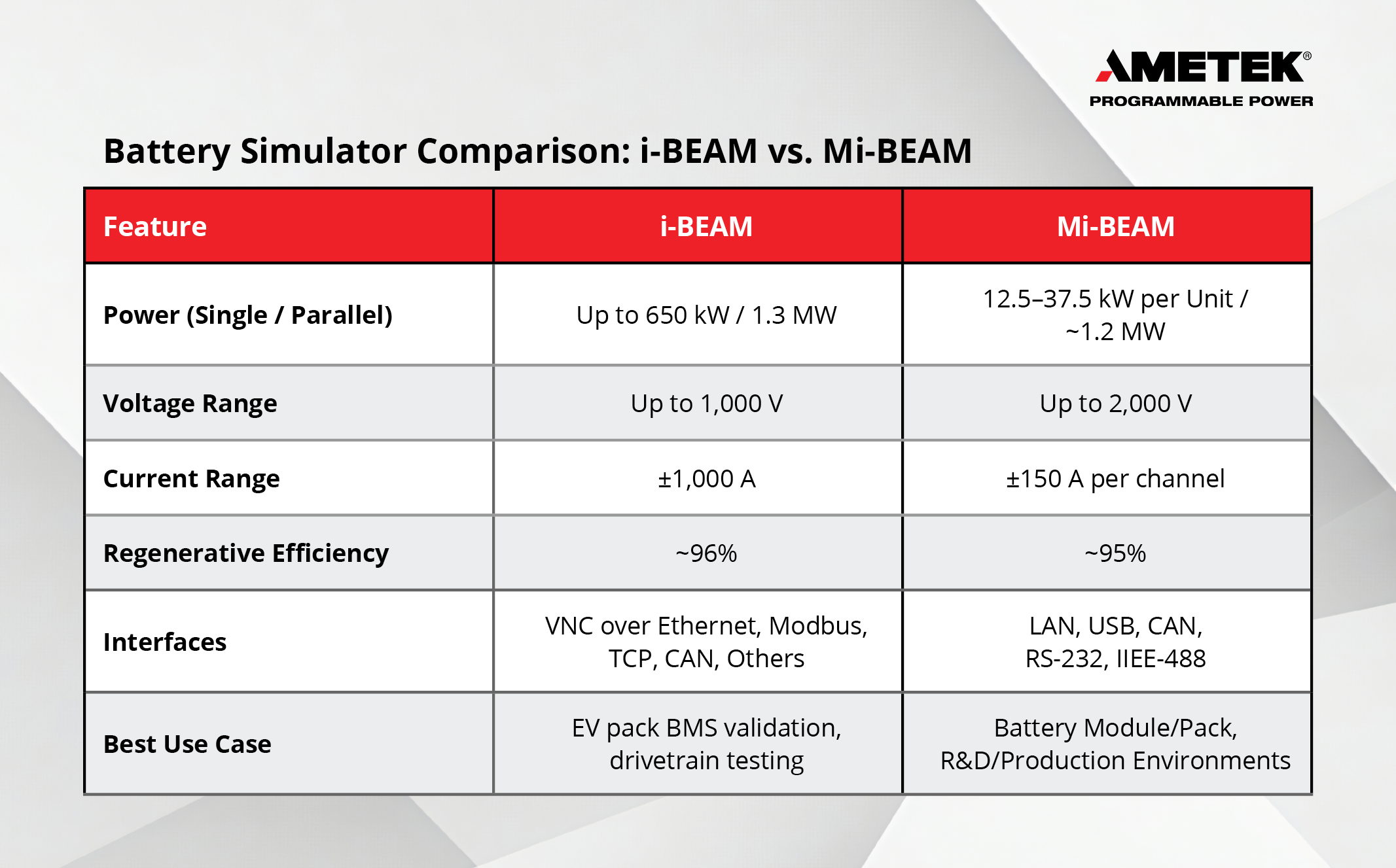
- High current pack testing → i‑BEAM.
- High voltage module/cell R&D → Mi‑BEAM.
- Industrial fieldbuses (EtherCAT/Profinet/CAN) → i‑BEAM; lab‑centric interfaces → Mi‑BEAM.
- Opex savings via regenerative energy recovery → both platforms.
Example Emulation Workflows
- Charger protection logic: Sweep SoC/internal resistance; inject over/under‑voltage; observe BMS responses.
- BMS HIL: Emulate multi‑cell battery model with faults; validate balancing, isolation, and diagnostics.
- EV drive cycle reproduction: Apply current/voltage lists; measure efficiency and thermal rise.
- Converter/inverter validation: Source↔sink transitions; ripple/noise checks; autoranging for broad operating points.
Safety, Compliance, and Practical Notes
Short‑circuit proof architectures; islanding detection; fieldbus integration; model management/versioning for battery emulator model libraries.
Frequently Asked Questions (Engineer‑Focused)
Battery emulator vs. power supply—what’s the difference?
A conventional supply can only source; a battery emulator must source and sink with variable internal resistance/ESR, realistic SoC behavior, and fast transitions.
Can i‑BEAM/Mi‑BEAM emulate packs for BMS HIL?
Yes—both platforms support battery simulation and drive‑cycle waveforms; choose i‑BEAM for high current packs and Mi‑BEAM for high voltage modules/cells.
How does regeneration reduce operating cost?
By returning absorbed energy to the AC line (~95–96% regenerative efficiency), reducing heat and utility usage in long tests.