



In modern industrial environments, precision, control, and high-performance equipment are non-negotiable. Among the most critical components enabling such performance is the High Voltage DC (HVDC) Power Supply. Whether in R&D labs, manufacturing floors, or high-voltage testing facilities, these supplies deliver the energy backbone needed for innovation and operation.
What Exactly is a High Voltage DC Power Supply?
A High Voltage DC Power Supply is an electrical device that converts standard AC input or low voltage DC into a higher, regulated DC output. These supplies are designed to deliver stable and controlled DC voltages typically ranging from hundreds to tens of thousands of volts.
Key Characteristics:
- High Output Voltage: Generally above 100V and extending up to 200kV or more.
- Regulated Output: Maintains a stable voltage despite load variations.
- Safety Features: Includes current limiting, voltage clamping, and arc protection.
These units are vital in systems where precision, safety, and reliability are paramount.
Classification of DC Power Supply Based on Voltage Range:
DC power supplies are typically classified based on their output voltage range:
- Low Voltage (0 – 100V): Used in consumer electronics, embedded systems, and LED testing.
- Medium Voltage (100V – 1kV): Common in industrial control systems and electrochemical processes.
- High Voltage (1kV – 30kV): Used in X-ray systems, particle accelerators, and plasma generation.
- Ultra-High Voltage (Above 30kV): Found in insulation testing, ion implantation, and HV cable testing.
Industrial Applications:
- Low Voltage: PCB testing in electronics.
- Medium Voltage: Battery simulation in EV R&D.
- High Voltage: Power electronics testing.
- Ultra-High Voltage: High-voltage insulation validation in utilities.
How a High Voltage DC Power Supply Works?
The fundamental working principle involves several stages of power conversion and regulation:
- AC to DC Conversion: The input AC power is first rectified using a diode bridge or similar converter.
- DC-DC Conversion & Voltage Boost: A step-up converter or transformer increases the voltage to desired levels. High-frequency switching is used to minimize size and improve efficiency.
- Filtering & Regulation: Capacitors and inductors filter out noise and stabilize output. Feedback control ensures constant voltage irrespective of load changes.
- Protection Mechanisms: Incorporates arc detection, over-voltage, and over-current protections.
Programmable Supplies: Modern HVDC supplies often include programmable interfaces (USB, RS-232, GPIB, Ethernet) for automation and precise control in lab and industrial environments.
Common Applications of High Voltage DC Power Supply:
High Voltage DC Power Supplies are indispensable in diverse fields:
- Medical Industry: X-ray machines, CT scanners, and electron microscopes. Programmable supplies allow fine-tuning for patient-specific diagnostics.
- Telecommunications: Satellite testing and RF amplifiers require stable HVDC inputs. Remote monitoring improves reliability in harsh environments.
- Automotive & EV Sector: Battery simulation, inverter testing, and insulation breakdown testing. Programmability enables real-world simulation scenarios.
- Research & Academia: Particle physics, plasma research, and ion beam experimentation. High-resolution control critical for experimental repeatability.
- Semiconductor Manufacturing: Ion implantation, photolithography, and wafer inspection. Precision voltage profiles support high-yield manufacturing.
Which Industry Has More Requirement of High Voltage DC Power Supply?
While many sectors utilize HVDC power supplies, the top industries include:
- Medical Equipment Manufacturing: Constant demand for high-precision imaging and therapeutic equipment. Programmable supplies enhance control in radiation therapy.
- Energy & Power Utilities: HV cable testing, insulation integrity checks, and substation equipment testing. Ultra-high voltage supplies needed for robust safety validation.
- Automotive (EV and Hybrid): HVDC charging station development and powertrain testing. Integration with real-time simulation systems for software-in-the-loop (SIL) testing.
- Aerospace & Defense: Radar systems, directed energy weapons, and avionics testing. High-reliability supplies with built-in redundancy are preferred.
How to Choose the Right High Voltage DC Power Supply?
Selecting the right HVDC power supply depends on several key factors:
- Voltage and Current Ratings: Identify maximum voltage and current requirements of the load. Consider future scalability needs.
- Load Type: Resistive, capacitive, or inductive loads impact the power supply's stability and response. Choose supplies with specific load compatibility.
- Control Interface: Programmable supplies offer digital and analog control. Ensure compatibility with existing automation and control systems.
- Safety and Compliance: Look for CE, UL, or ISO-certified units. Integrated safety features like interlocks and fault logging are crucial.
- Environmental Factors: Consider cooling methods, size, and mounting style. For harsh conditions, look for ruggedized enclosures.
Explore Our Product:
Our high voltage DC programmable power solution “Sorensen™ Modular Intelligent-Bidirectional Energy AMplified (Mi-BEAM) Series” is built to support a wide range of advanced energy applications. One of its key features is battery simulation, which allows engineers to accurately emulate battery behavior under different conditions. This is essential for testing systems that rely on battery inputs without needing a physical battery.
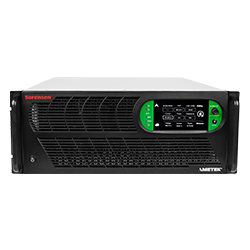 |
| Sorensen™ Modular Intelligent-Bidirectional Energy AMplified (Mi-BEAM) Series |
It also supports battery testing, including both charge and discharge cycles. This enables precise performance analysis and helps ensure battery safety, efficiency, and long-term reliability.
For electric powertrain testing, the system provides stable and programmable high-voltage DC power. It can simulate real driving scenarios, helping manufacturers test motor performance, inverter efficiency, and overall system response.
Our solution is also ideal for fuel cell testing, offering the controlled environment needed to analyze cell stack performance and optimize system integration.
In addition, it supports solar inverter testing by simulating various photovoltaic output conditions. This allows users to evaluate inverter performance across a range of solar input profiles.
With fast response times, robust safety features, and an intuitive interface, this power solution is perfect for R&D, validation, and production environments. It’s a flexible and reliable tool for engineers working on the future of renewable energy and electric mobility.
Final Thoughts
High Voltage DC Power Supplies are the backbone of numerous modern technologies. As industries continue to demand greater precision, automation, and reliability, programmable HVDC supplies are becoming the standard. Whether for R&D, production, or critical infrastructure, selecting the right unit is a balance of performance, protection, and programmability.
Investing in a well-engineered, application-specific HVDC power supply like Sorensen™ Modular Intelligent-Bidirectional Energy AMplified (Mi-BEAM) Series not only enhances efficiency but also ensures safety and reliability for mission-critical operations.