



Frustrated with battery tests that take too long, risk damage, or deliver unreliable results? You're not alone. As the demand for high-performing batteries in EVs and renewable energy systems surges, so does the need for precise and efficient testing. While general-purpose bidirectional power supplies might seem like a go-to solution, they often leave critical battery-specific testing challenges unaddressed. This post dives into the key considerations for choosing a bidirectional power supply that's truly up to the task of rigorous battery evaluation.
Testing batteries isn’t like testing any other component
As the renewable and electric vehicle (EV) markets continue to grow, so does the demand for the key components built into them. Batteries represent one such type of component, and just like all other components, batteries need to be tested at various stages—for example, at the cell level and the completed battery-pack level. Battery test presents certain unique considerations and challenges not found when testing other types of units under test (UUT). Knowing how batteries are constructed and behave is key in deciding what type of instruments are best suited to test them.
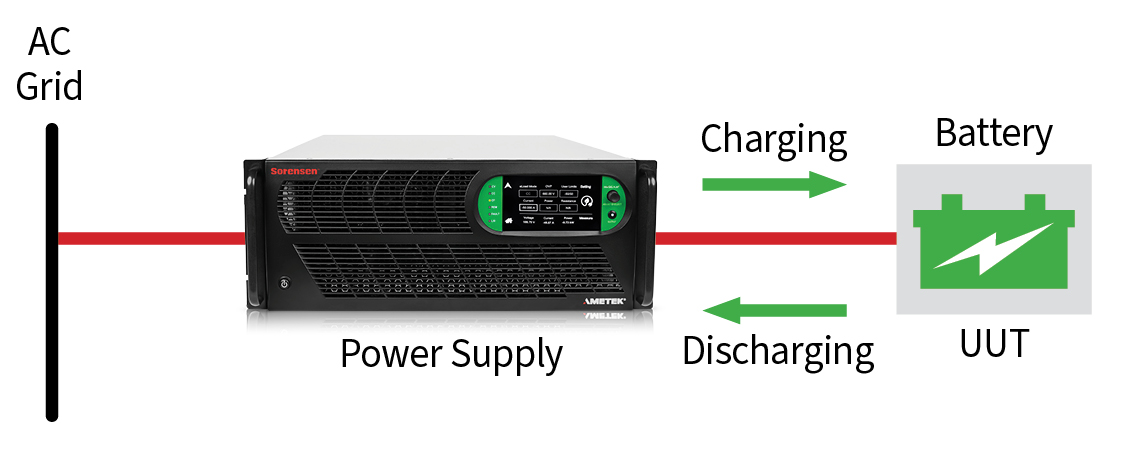
Often thought as the main solution for testing batteries, general-purpose bidirectional power supplies satisfy some requirements. As shown in Figure 1, the bidirectional supply can both source and sink power, so it can exercise a battery’s charging cycle, where the supply provides power to the battery, and it can exercise the battery’s discharge cycle, where the supply can sink energy from the battery and regenerate it to the AC grid.
Figure 1. A bidirectional power supply can source and sink power from a UUT, such as a battery.
However, a standard off-the-shelf bidirectional supply leaves many battery test challenges untouched. As an alternative, purpose-built battery testers or bidirectional power supplies with dedicated battery-test options target these specific requirement shortfalls and ensure the proper testing of batteries and their supporting components.
Energy storage challenges
First among the specific challenges, batteries are energy-storage devices that store a finite amount of energy, which can be discharged rapidly or slowly, both of which can cause problems. If not tested carefully, the battery energy can be discharged rapidly, causing permanent damage to the battery or imposing lengthy battery recouperation periods that increase test times and costs. In addition, many standard bidirectional DC power supplies lack output isolation. If a battery is left connected to such a supply, even with the supply turned off, the internal resistance of the supply can discharge the battery over time, making it impossible to continue a test that, for example, was interrupted overnight.
Large inrush currents
Typical bidirectional DC supplies have large output capacitances that present low impedances to a fully charged battery when that battery is first connected. Because batteries are capable of high discharge rates, they can deliver large inrush currents until the supply’s output capacitance charges. Without additional considerations for inrush-current control through pre-charge circuits, for example, battery and test equipment damage can occur. Contactors, for example, can undergo pitting and arcing.
Battery-specific parameters
Battery test makes use of specific measurement parameters not typically associated with other types of UUTs. These parameters include ampere-hour (Ah) and kilowatt-hour (kWh), which many general-purpose power supplies will not support without requiring additional higher-level software steps. Having these measurements directly available on the test instrument not only saves programming time, but it also adds efficiency and accuracy to the system by reducing programming complexity.
Dynamic response
In addition, a battery is very dynamic in that not only is it capable of providing current extremely quickly, but it is also able to quickly change its voltage depending on the current magnitude and direction. As such, in order to sufficiently test a battery, the test equipment must be as quick or quicker in its voltage and current transient capabilities. As mentioned, general-purpose power supplies typically have very high output capacitance—on the order of tens of thousands of µF—coupled with slower transistor switching frequencies and sluggish controls operation, making their voltage and current changes much slower.
An approach to battery test
One approach to battery test is to use the AMETEK Programmable Power Modular intelligent-Bidirectional Energy AMplified (Mi-BEAM) programmable power supply equipped with the BATTEST option. With the option installed, users can create multiple charging and discharging profiles and sequence them in various ways to mimic real-world battery operation to glean insights on battery performance, efficiency, and health. Mi-BEAM supports seamless dynamic transitions between charging and discharging operation, as shown in Figure 1, to provide for uninterrupted test.
Mi-BEAM includes several features useful specifically for battery test. It includes an output isolation relay that can disconnect a battery under test in response to a fault condition or when the power supply is turned off.
Unlike a purpose-built battery tester, the Mi-BEAM offers the flexibility to perform operations other than battery test. For example, if you are testing batteries, you may also need to test a battery charger or a battery management system (BMS), for which you will need a battery simulator. For that purpose, you can select Mi-BEAM’s BATSIM option, which users can activate under either software control or via the instrument’s front panel (Figure 2).
Figure 2. Depending on installed hardware and software options, Mi-BEAM offers the flexibility to serve a variety of dedicated functions, including battery simulation (BATSIM) and battery test (BATTEST).
With this mode installed, users can simulate a variety of battery chemistries, choosing from built-in battery models for commonly used battery types such as lithium-ion (Li-ion) and lead-acid. Alternatively, they can develop their own models or purchase battery models from third parties. Users can fine-tune various battery parameters such as voltage, current, and state of charge (SOC), and they can choose whether to import voltage or SOC data. Like the BATTEST option, BATSIM supports seamless dynamic transitions between charging and discharging cycles. Figure 3 at the top shows the Mi-BEAM operating in charge mode, where the Mi-BEAM is absorbing energy from a DUT, which could be a charger. In the figure at the bottom, the Mi-BEAM is running in discharge mode, providing power to the UUT, which could be an EV traction inverter.

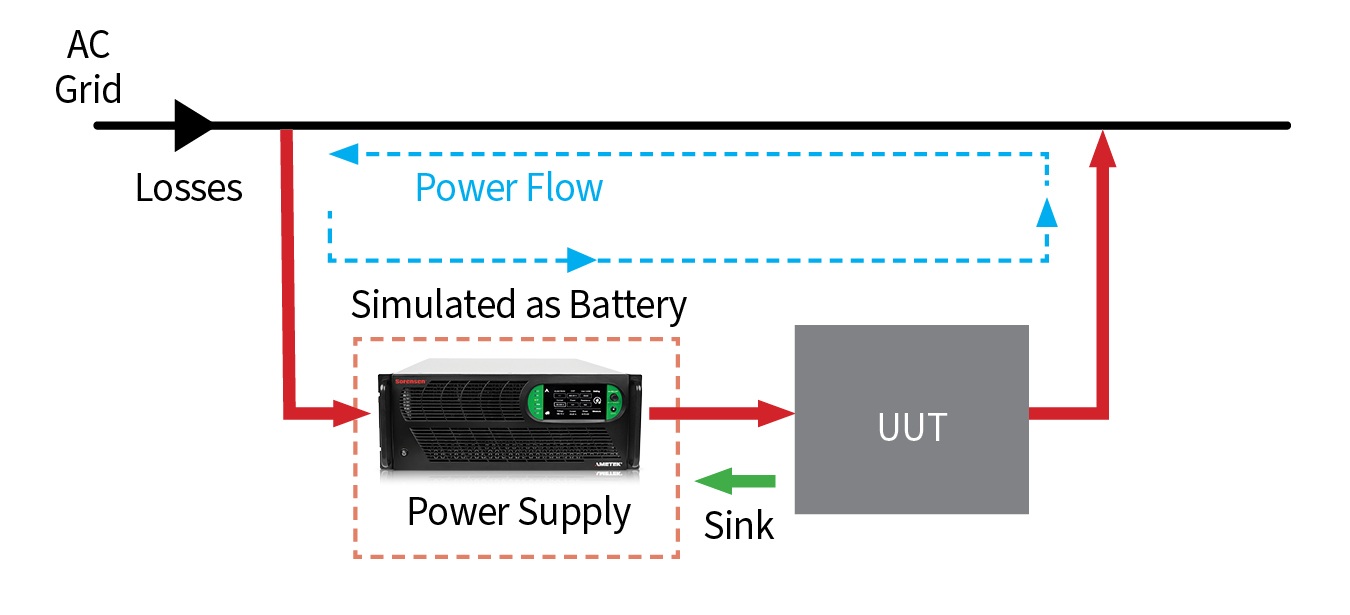
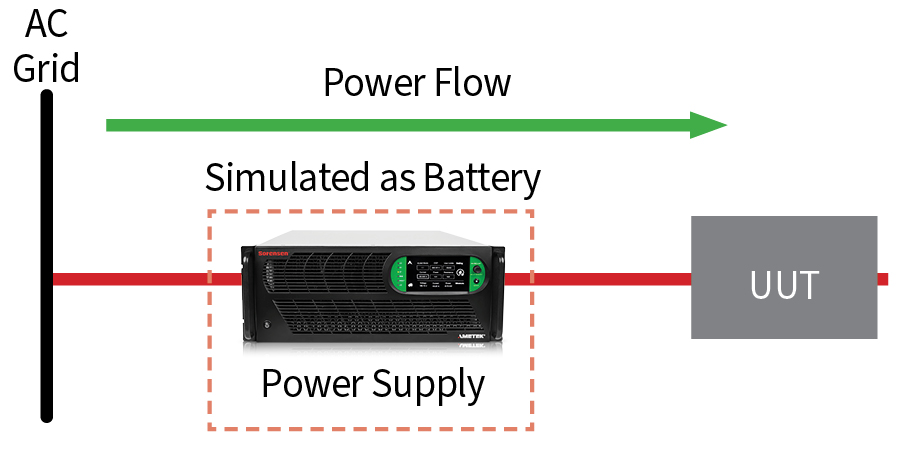
Figure 3. Equipped with the BATSIM option, Mi-BEAM can operate in battery-simulation charge mode (top) or discharge mode (bottom).
Conclusion
Given a battery’s energy capacity, extreme care must be taken regarding testing them. Otherwise, failures such as component damage, exothermic events, and even facility damage can occur. Since many bi-directional power supplies do not have galvanic output isolation, pre-charge circuits, or polarity detection, this opens up the possibility for these types of failures. For practical, safe, and reliable battery testing, choose a purpose-built battery tester or a modular bidirectional supply that comes with a dedicated battery test option that includes the hardware and software that addresses factors such as inrush currents, dynamic performance, and isolation and that can present measurement results in parameters specific to the battery test environment.
Reference
Jackson, Ben, “What’s the Difference Between a Battery Tester and a Bi-directional Power Supply?,” EV Engineering & Infrastructure, April 2025. https://www.evengineeringonline.com/whats-the-difference-between-a-battery-tester-and-a-bi-directional-power-supply/
Check out even more information in our white papers, application notes, and guides:
Bidirectional Programmable DC Power Supplies Augment Simulation and Test
Programmable Bidirectional, Regenerative DC Power Aids Battery, Inverter, Fuel-Cell, and Motor Test Across Multiple Industries
Programmable Power Supplies Keep Racing Team on Track