



Introduction
Electric vehicles are entering a new era of performance, driven by architectures that push beyond the traditional 400 V standard to 800 V—and even 1500 V in specialized applications. These higher voltages promise faster charging, reduced conductor size, and lighter overall systems, but they also introduce significant challenges for testing and validation. Engineers must ensure that batteries, power electronics, and supporting systems operate reliably under these demanding conditions. This evolution is reshaping the tools and strategies used in development labs and production environments.
Higher Voltages Demand Advanced Testing Capabilities
EV battery voltages are climbing from 400 to 800 V and beyond. In some material handling and construction equipment applications, voltages are reaching 1500 V. The key benefit of higher voltages in these applications is that they reduce the size (gauge) of the conductors, lower system weight, and enable faster charging times.
Testing battery packs at these higher voltages requires test equipment that has equivalent voltage and power ratings. Bidirectional and regenerative programmable power supplies have evolved to meet these requirements and are now being used to test these high-voltage batteries.
Balancing Real Battery Testing with Emulation
Testing real battery performance is required to ensure that the battery meets its intended design objectives to accept and release charge to power the EV over its lifetime. Extended testing is also required to ensure that rigorous drive cycles meet or exceed industry or manufacturer standards.
Emulation enables testing of other EV components—such as DC motors, EV chargers, and other drivetrain components—without having to rely on the battery itself. Using a single piece of test equipment that manages all these requirements in R&D can also enable a smooth transition to production test without additional investment.
Consolidating Test Functions to Accelerate Timelines
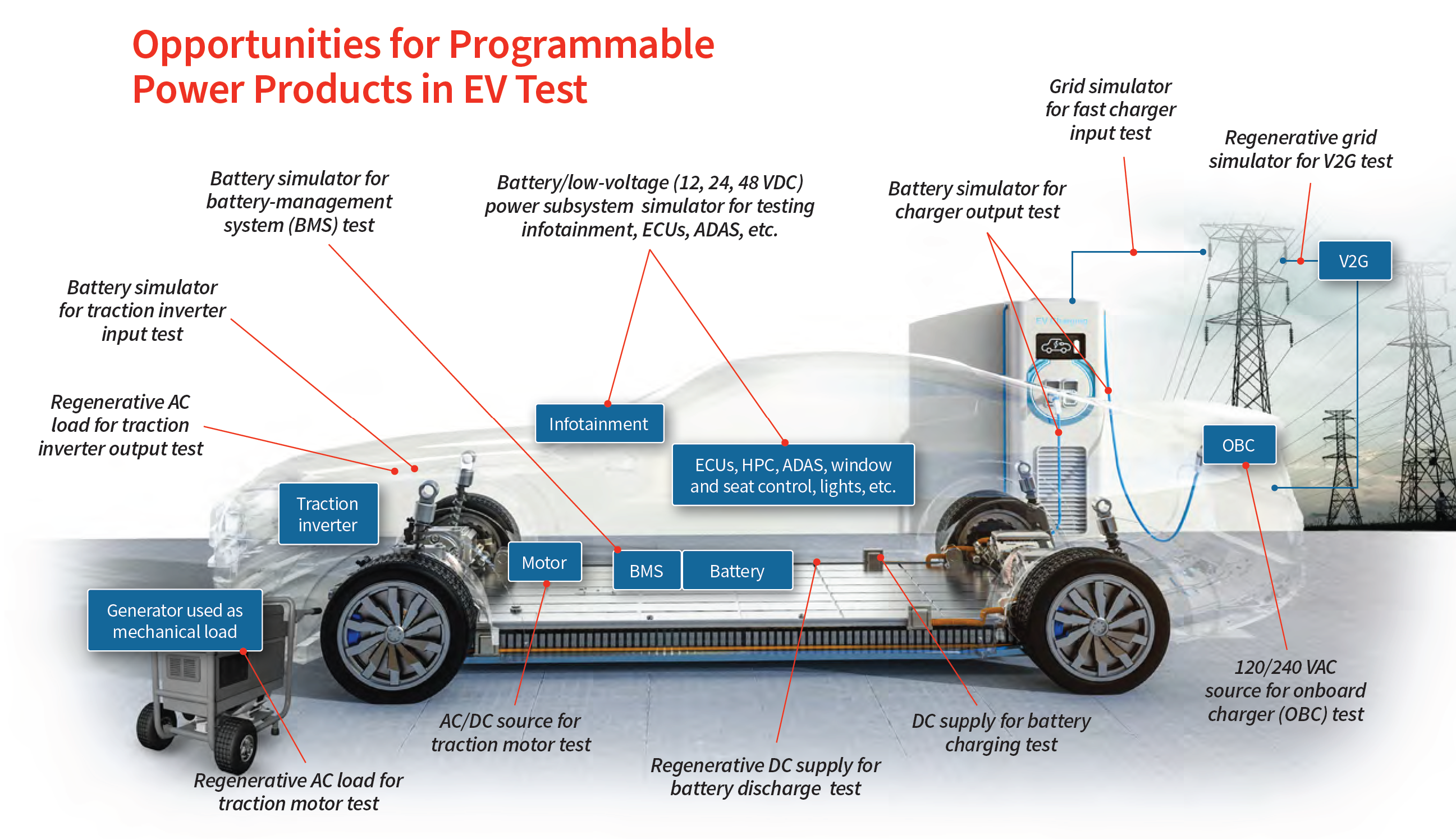
Programmable, bidirectional, and regenerative test systems typically provide the capabilities required to perform multiple tests in a single box. Before the advent of these new test systems, multiple pieces of equipment were required, such as a programmable DC power supply, a programmable DC electronic load, and high-power switching systems to manage all the required test scenarios.
These systems took additional time to setup and manage the connections which, ultimately, extended the test time.
Energy Recovery and Thermal Management in High-Power Testing
Thermal control for the unit under test is typically managed by the device. However, the benefit of having a bidirectional and regenerative programmable DC power supply is its regeneration capability.
Older programmable DC electronic loads used for discharging batteries typically burned off that power as heat. This excess heat required additional cooling in the test lab or factory to maintain environmental conditions, adding cost.
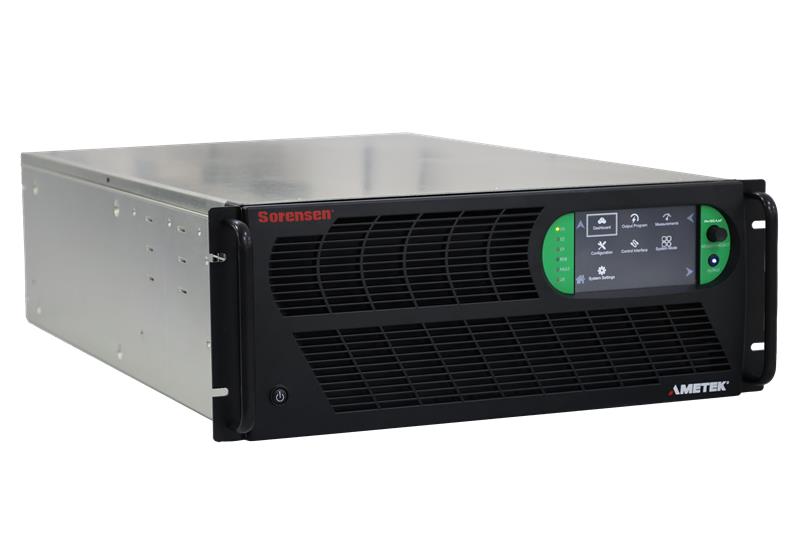
The Sorensen Modular intelligent-Bidirectional Energy AMplified (Mi-BEAM) series from AMETEK is a bidirectional, regenerative DC supply designed for EV battery and subsystem testing. Its regeneration feature can return up to 95% of energy back to the grid instead of wasting it as heat.
Regeneration can reduce electricity costs and benefit other operations within the facility. In addition, some multi-channel products can reuse energy internally—using discharge power from one battery to supplement the charge power for another battery.
Configuring test programs with this feature can also reduce the power requirement of the overall system for additional savings.
Simulating Real-World Conditions for Complete Validation
Battery simulators must mimic many different charging and discharging characteristics, which depend on battery chemistry, capacity, state of charge (SOC), and other conditions.
A suitable bidirectional DC power supply must be able to source and sink current and support standard or custom battery models that define characteristics. One significant differentiator between a bidirectional DC power supply and a battery simulator is the presence of series resistance.
Expanding Test Coverage for Emerging EV Technologies
As the EV market evolves, testing challenges extend from grid-connected chargers and vehicle-to-grid (V2G) equipment to vehicle high- and low-voltage batteries. They also span critical subsystems—from power semiconductors in traction inverters to the high-performance computing (HPC) and advanced driver assistance system (ADAS) processors that impact performance and safety.
Validating high-voltage charging systems requires programmable power sources and battery simulators that can replicate real charging conditions. Programmable power plays a central role in testing EV performance, ensuring that all components work together under a wide range of operating voltage and current conditions.
An effective power supply used in this application should also include a list/waveform-generation function to create sequences of voltage and current ramps with programmable start, dwell, and stop times to support a variety of drive-cycle tests. Seamless transitions between source and sink operation can enable transient response times of less than a millisecond to better validate real-world conditions.
Other features to look for in a bidirectional programmable DC power supply include software, data logging, external inhibits, and safety capabilities to prevent damage to the unit under test and other equipment. While it’s possible to develop custom test programs, native software—such as a graphical user interface (GUI) that brings instrument control from the front panel to your computer screen—can help you get up and running quickly, improve troubleshooting, and reduce time-to-test.
Conclusion
The shift to higher-voltage EV architectures is redefining how engineers approach testing and validation. By leveraging bidirectional, regenerative, and highly configurable power platforms, manufacturers can streamline workflows, reduce costs, and ensure that next-generation electric vehicles meet stringent performance and safety standards.